
Middle schoolers are hard on themselves. One bad quiz, an awkward lunch table, or a comment about their hair, and the inner voice gets loud.
Positive affirmations won’t fix all of that, but they give kids something better to repeat. A line like “I can figure this out” or “One mistake doesn’t define me” can change what plays in their head when things feel off.
Below are middle school positive affirmations sorted by what kids deal with most: confidence, test stress, friendships, mistakes, body image, and anxiety. I kept them plain on purpose. Kids can tell when something sounds fake, and they won’t say it.
The free printable is right below the lists. Read through the affirmations, pick the ones that fit, then print the pages to match.
How Positive Affirmations Help Middle Schoolers
Between ages 11 and 14, kids become much more tuned in to what their peers think. Research on the teenage brain suggests the circuits that process social evaluation respond with heightened emotional intensity during adolescence. The prefrontal connections that help regulate emotion are also still maturing. So a small thing, like an awkward comment or a bad grade, can feel much bigger than it is.
Self-affirmation gives kids a way to steady themselves. In a two-year Science study, 7th graders completed short, structured writing assignments about a value that mattered to them, and African American students’ GPAs rose by 0.24 points on average. Low-achieving students gained 0.41 points and were less likely to repeat a grade (5% vs. 18%). The writing made no difference for African American students who were already doing well, or for European American students, so it helped most where the pressure was highest. The researchers’ explanation is that small early changes in confidence can snowball over time.
There’s one catch. In a study on positive self-statements, people with low self-esteem who repeated “I’m a lovable person” felt worse than those who didn’t repeat it. The authors warned that over-the-top statements may harm the people they’re meant to help. That’s why the affirmations below are believable. A kid who feels behind in math won’t buy “I’m brilliant at everything,” but “I can figure this out” is easier to accept.
Positive Affirmations for Middle School Students
Pick the ones that feel true and skip the rest. A line a kid doesn’t believe won’t do much.
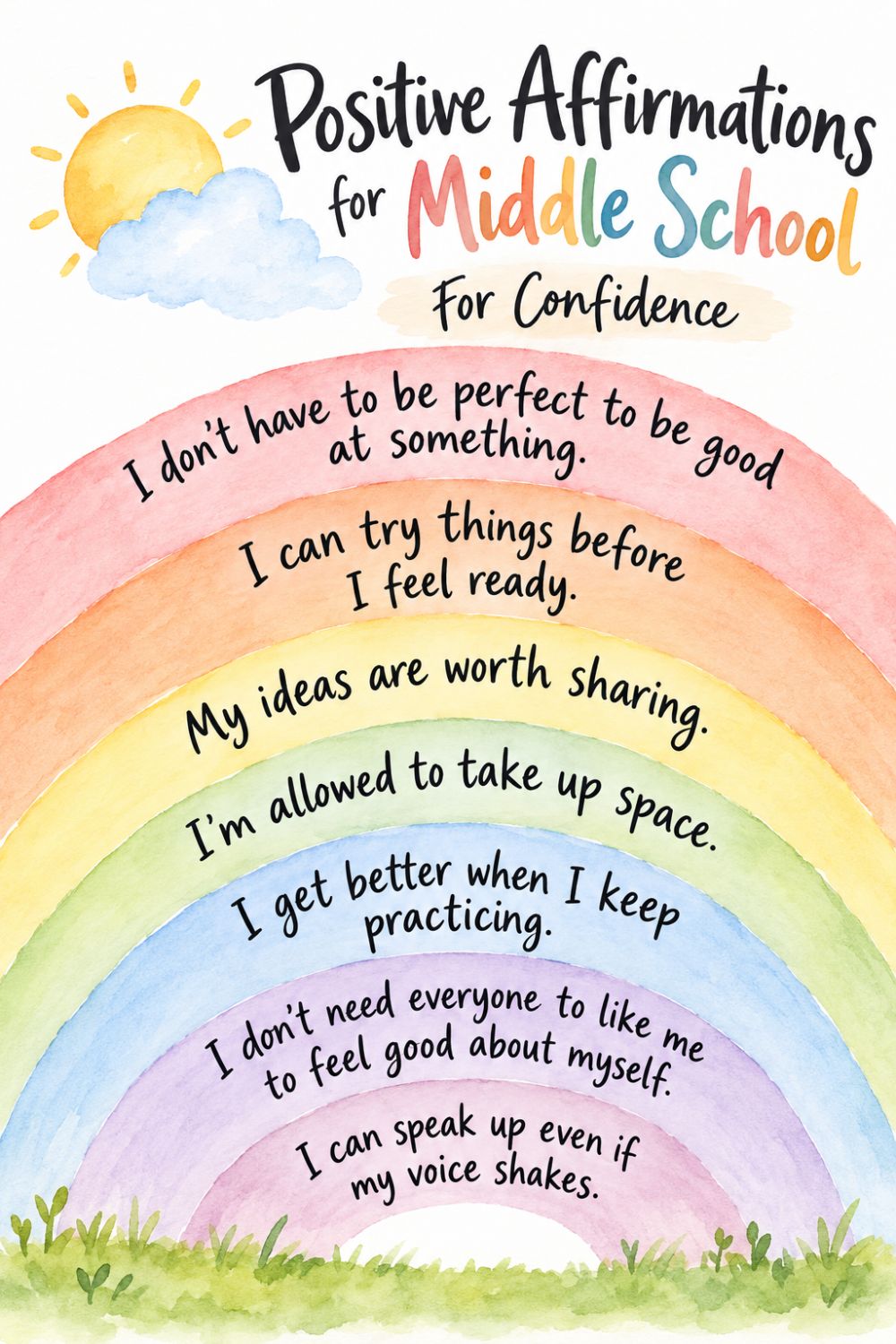
For Confidence
- I don’t have to be perfect to be good at something.
- I can try things before I feel ready.
- My ideas are worth sharing.
- I’m allowed to take up space.
- I get better when I keep practicing.
- I don’t need everyone to like me to feel good about myself.
- I can speak up even if my voice shakes.
If speaking up is the hard part, give your child a low-stakes way to practice. These speech topics for middle school students are easy to start with.
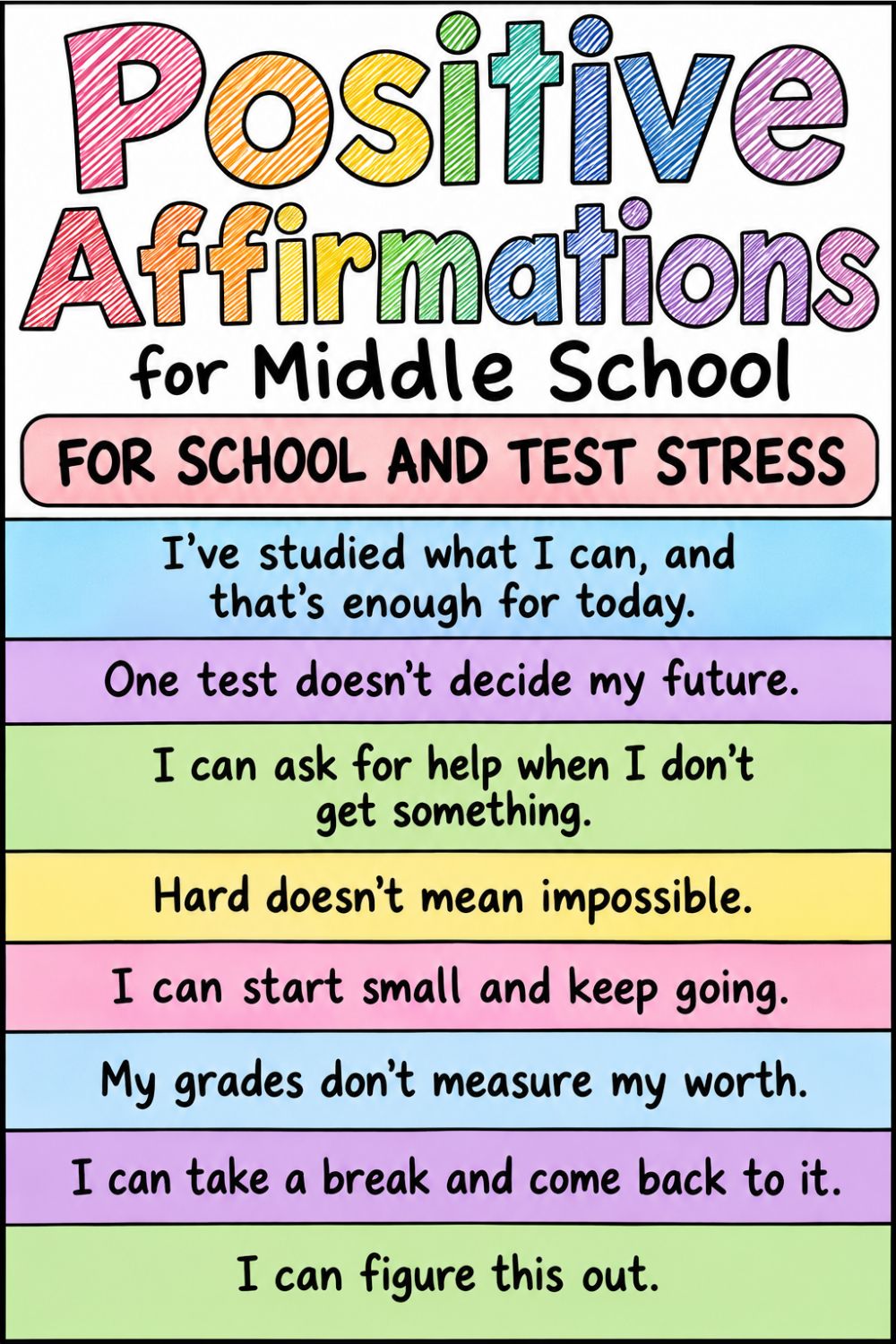
For School and Test Stress
- I’ve studied what I can, and that’s enough for today.
- One test doesn’t decide my future.
- I can ask for help when I don’t get something.
- Hard doesn’t mean impossible.
- I can start small and keep going.
- My grades don’t measure my worth.
- I can take a break and come back to it.
- I can figure this out.
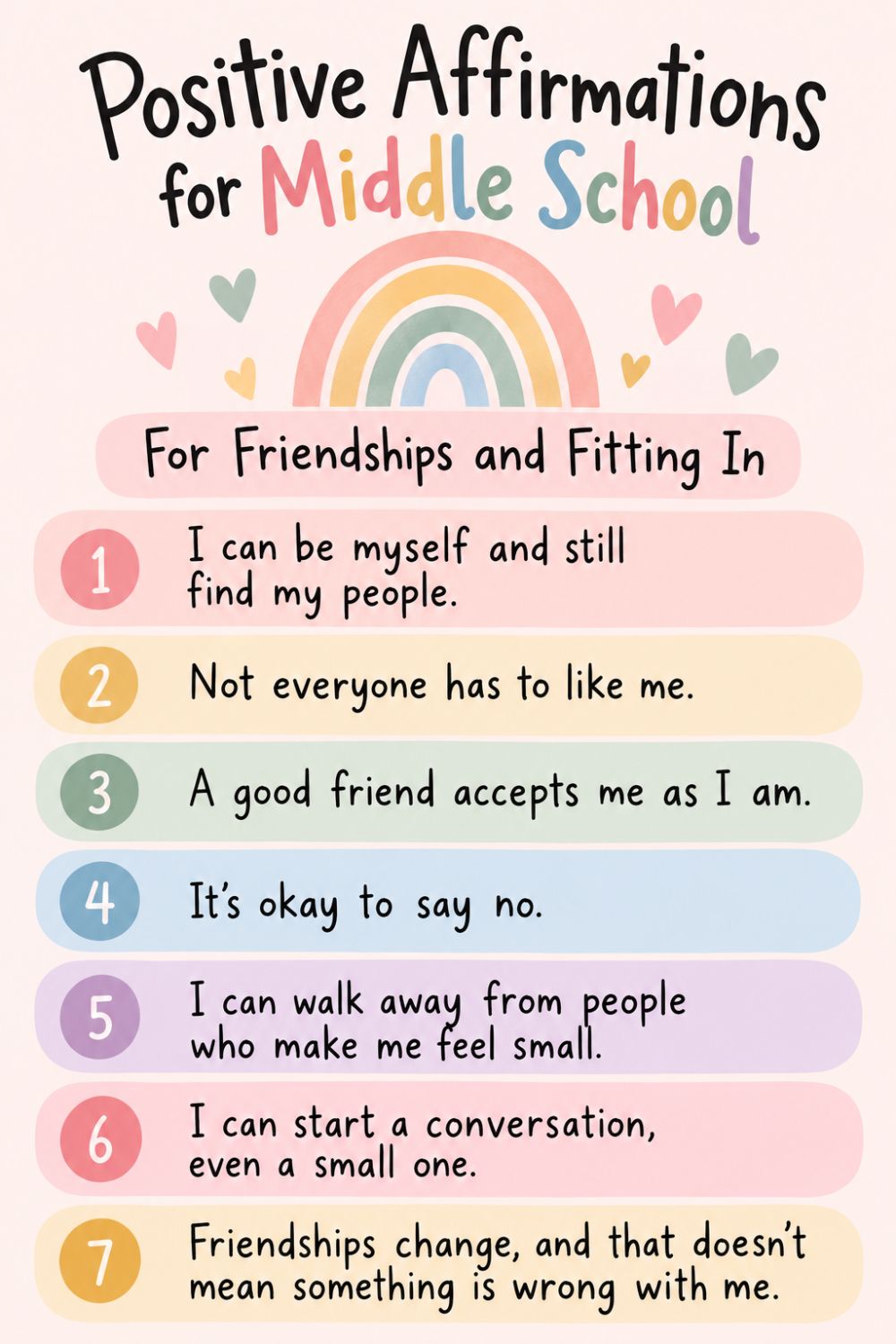
For Friendships and Fitting In
- I can be myself and still find my people.
- Not everyone has to like me.
- A good friend accepts me as I am.
- It’s okay to say no.
- I can walk away from people who make me feel small.
- I can start a conversation, even a small one.
- Friendships change, and that doesn’t mean something is wrong with me.
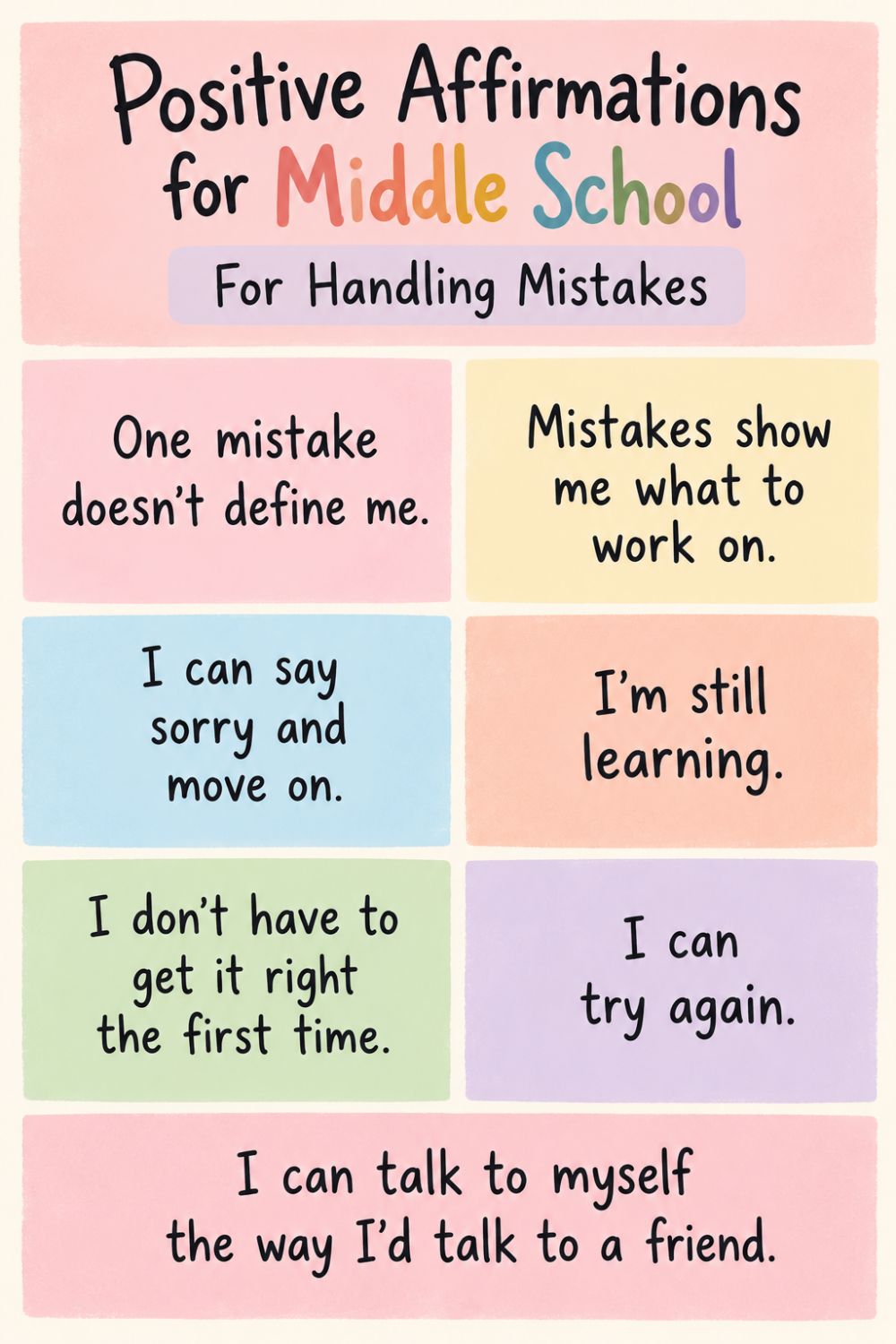
For Handling Mistakes
- One mistake doesn’t define me.
- Mistakes show me what to work on.
- I can say sorry and move on.
- I’m still learning.
- I don’t have to get it right the first time.
- I can try again.
- I can talk to myself the way I’d talk to a friend.
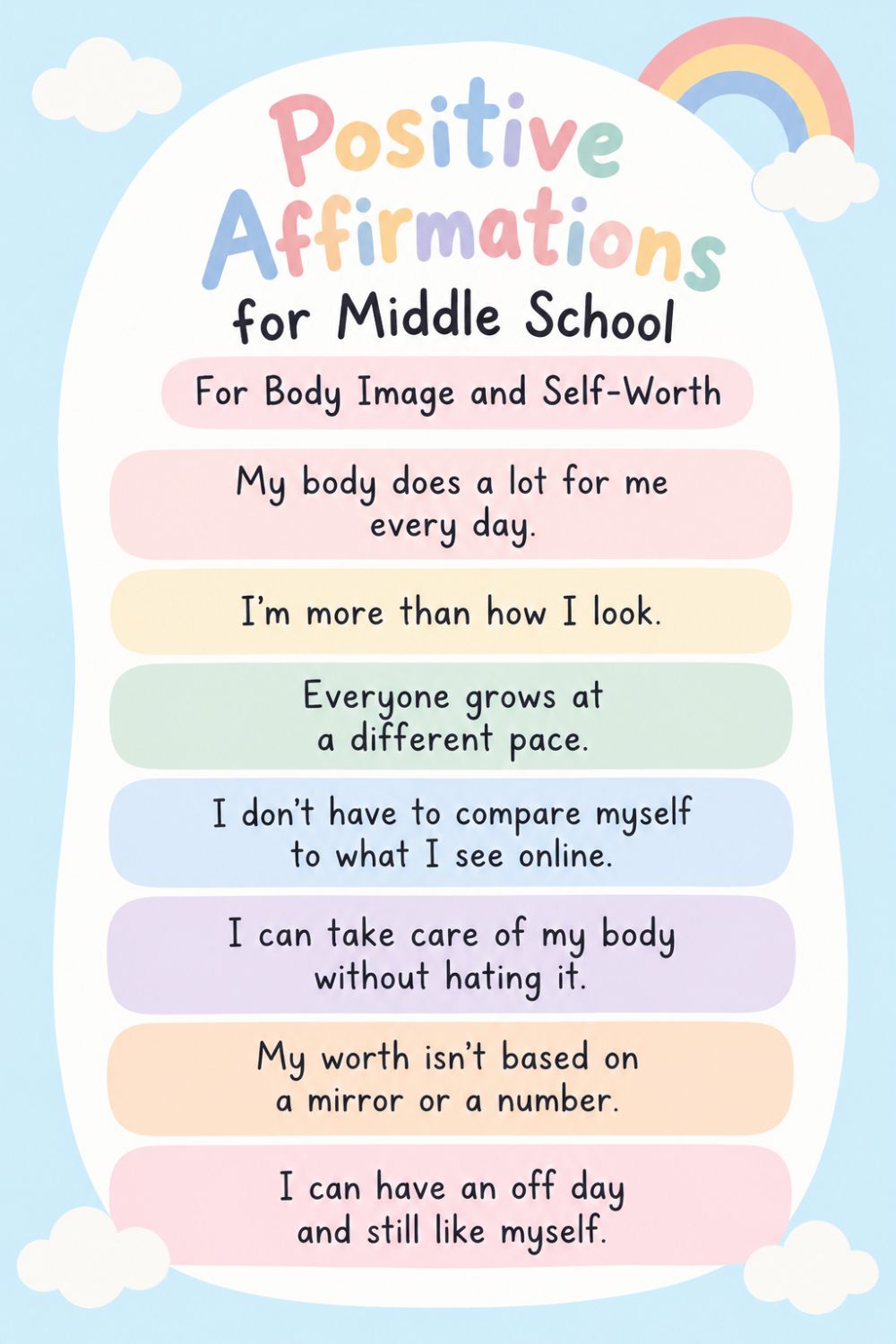
For Body Image and Self-Worth
- My body does a lot for me every day.
- I’m more than how I look.
- Everyone grows at a different pace.
- I don’t have to compare myself to what I see online.
- I can take care of my body without hating it.
- My worth isn’t based on a mirror or a number.
- I can have an off day and still like myself.
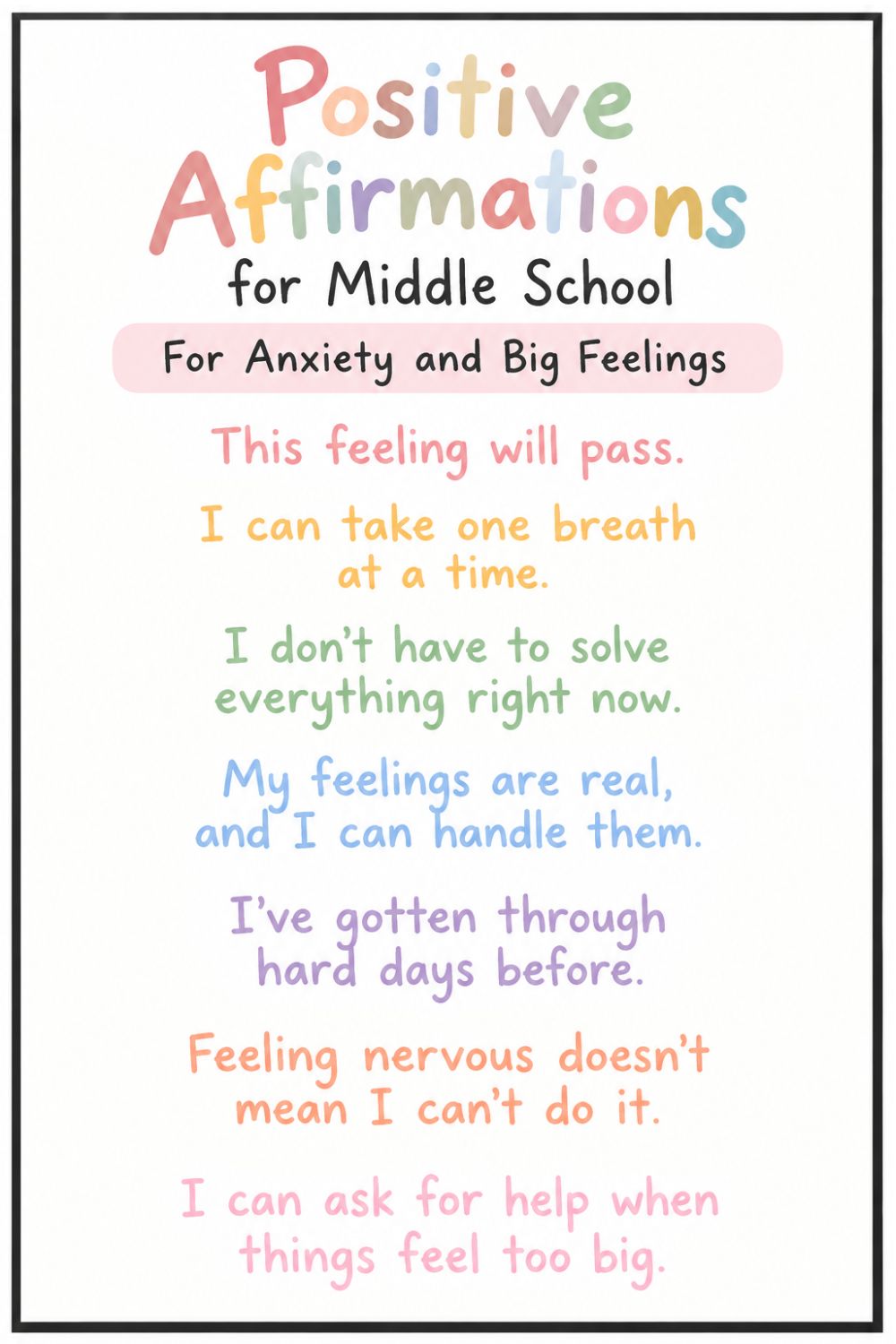
For Anxiety and Big Feelings
- This feeling will pass.
- I can take one breath at a time.
- I don’t have to solve everything right now.
- My feelings are real, and I can handle them.
- I’ve gotten through hard days before.
- Feeling nervous doesn’t mean I can’t do it.
- I can ask for help when things feel too big.
If worry or sadness feels constant, a trusted adult or school counselor can help more than any affirmation can.
Free Printable Positive Affirmations for Middle School
Get all 6 categories of affirmations in one printable PDF. Print the full set or just the page you need, like test stress before exams or friendships when things feel off.
How to Use Affirmations With Middle Schoolers
Affirmations stick when they’re attached to something kids already do. Start with one or two, not the whole list.
5 Easy Ways to Use Them
- Locker door: Tape a card inside so it’s the first thing they see between classes.
- Planner: Tuck one into the cover, or write one next to the day’s hardest task.
- Bathroom mirror: Stick one up and read it while brushing teeth.
- Morning routine: Pick one at breakfast or on the walk to school and say it once.
- Journal prompt: Choose one and write about a time this week it felt true. If they enjoy writing, these story prompts for middle schoolers are a good next step.
A 5-Minute Affirmation Activity
This works at home or in a classroom. It’s inspired by the writing exercise from the research above, and it makes the affirmation personal, not just words on a card.
- Pick one affirmation. Choose one from the lists above, or write your own. It should feel at least a little true.
- Read it out loud, once. Saying it aloud makes it feel less like a worksheet.
- Write why it matters. Under the affirmation, finish this sentence in 2-3 lines: “This matters to me because…”
- Add a real example. Write one time it was true, even a small one. For “I can figure this out,” that could be a math problem they eventually solved.
- Put it somewhere visible. Locker, planner, or mirror. Keep it up for a week, then swap it for a new one.
If a kid can’t think of an example in step 4, switch to a different affirmation. It means the first one doesn’t feel believable yet.
For Parents: Let your child choose their own, and share one of yours. Kids tune out affirmations that feel like a lecture, so keep it casual.
For Teachers: Put one on the board each week and use the activity above as a 5-minute writing warm-up. Keep sharing optional, since not every student will want to read theirs aloud. It also pairs well with printable classroom rules for middle school at the start of the term, so the tone is set early.
If They Roll Their Eyes: That’s normal at this age. Leave a card where they’ll find it and move on. Most kids come around when it isn’t pushed. Humor is another easy way in. Sharing one of these middle school jokes alongside the card keeps things light.
Tips to Make Affirmations Actually Work
Saying a nice line once a month won’t change much. What helps is choosing affirmations kids believe in and using them in a way that fits their day. These five habits make the difference.
Let Kids Pick Their Own
An affirmation chosen by a kid feels like theirs. One handed to them feels like homework. Let them skim the lists and circle two or three that stand out, even if they pick ones you wouldn’t.
Keep Them Believable
If a statement feels false, it can backfire, as the research above showed. Try this fix: if “I’m great at math” feels like a stretch, change it to “I’m getting better at math” or “I can figure this out.”
Say Them Out Loud, Then Write Them Down
Saying it makes it real, and writing it makes it personal. After reading an affirmation, have them add one line on why it matters to them or when it was true. The writing is the part the research supports.
Make It a Daily Habit
Short and regular is easier to keep up than long and occasional. Attach it to something they already do, like brushing teeth or packing a bag, and it takes about a minute.
Swap Them Out Every Week or Two
If an affirmation stops feeling like anything, replace it. Let the kid’s current stress decide what comes next, whether that’s a test week, a friend fight, or a rough patch.
Wrapping up,
Middle school is hard, and no list of affirmations will change that overnight. But a few kind words, repeated on purpose, can make the rough days a little easier to get through.
Start small. Pick two or three affirmations from the lists above, the ones your kid could actually say without cringing. Put them where they’ll be seen, like a locker door, a planner, or a mirror. Every week or two, swap them for new ones based on what’s going on.
It may feel awkward at first, and that’s normal. If a line doesn’t land, change the wording instead of giving up on the whole idea. The writing activity is also worth trying, since a line in their own words feels more personal than one from a list.
When you’re ready, download the printable and print the page that fits this week.

An engineer, Maths expert, Online Tutor and animal rights activist. In more than 5+ years of my online teaching experience, I closely worked with many students struggling with dyscalculia and dyslexia. With the years passing, I learned that not much effort being put into the awareness of this learning disorder. Students with dyscalculia often misunderstood for having just a simple math fear. This is still an underresearched and understudied subject. I am also the founder of Smartynote -‘The notepad app for dyslexia’,