
An argumentative essay is where you pick a side on an issue, back it up with facts and reasons, and show why the other side doesn’t hold up. For middle schoolers, the hardest part usually isn’t the writing; it’s choosing a topic that has two real sides and enough information to work with.
This post gives you 25 argumentative essay topics for middle school, plus a few tips for picking one and getting started. There’s also a free printable list at the end.
What Makes a Good Argumentative Topic?
good topic gives you something real to argue. Before you commit, check that it meets these four points:
- It has two real sides. If everyone agrees (like “bullying is bad”), there’s nothing to argue. “Should phones be allowed in class?” works because people genuinely disagree.
- You can find facts to support it. Opinions alone won’t carry an essay. Look for topics where you can back up your claim with studies, examples, or statistics.
- It matters to you or your age group. You’ll write a stronger essay on school start times than on something you’ve never thought about.
- It’s narrow enough to cover. “Is technology good?” is too broad. “Should AI tools be allowed for homework?” is easier to handle.
If a topic passes all four, you’re good to go. Need a refresher on how argumentative essays are structured? The Purdue OWL guide to argumentative essays covers it well.
Argumentative Essay Topics for Middle School
Here are 25 topics with two real sides and plenty of facts to back them up. Pick one that makes you want to argue. If you want even more options, these fun debate topics for students also work well as essay topics.
School life
- Should school start later in the morning?
- Should students be allowed to use phones in class?
- Should schools require uniforms?
- Is homework helpful or a waste of time?
- Should students get longer recess?
- Should schools ban junk food and sugary drinks?
- Should schools switch to a four-day week?
- Should schools stop giving letter grades?
Tech and social media
9. Should kids under 14 be allowed on social media?
10. Is gaming good or bad for students?
11. Should students be allowed to use AI tools for homework?
12. Should parents set screen time limits?
13. Is online learning as good as in-person classes?
Everyday life
14. Should kids get paid for doing chores?
15. Should middle schoolers have a set bedtime?
16. Are zoos good for animals?
17. Should pets be allowed in schools?
18. Should every student learn a second language?
19. Should schools teach money management?
Society and community
20. Should community service be required to graduate?
21. Should professional athletes be role models?
22. Should school sports be mandatory?
23. Should plastic bags and bottles be banned?
24. Should kids have a say in school rules?
25. Is it fair to give every student a participation trophy?
How to Pick a Topic and Start Writing
Once you’ve scanned the list, the next step is choosing one and turning it into a first draft. Here’s how to do both without getting stuck.
Picking your topic
- Go with the one you have an opinion on. If you feel strongly about a topic, the reasons come much easier. You’ll also stay interested long enough to finish the essay.
- Do a quick fact check. Spend two minutes searching the topic. If you find a few solid facts, studies, or real-life examples, it’s a keeper. If you only find opinions, move on to another one.
- Test the other side. Try to think of at least one good argument against your view. If you can’t, the topic may be too one-sided. Talking it through with a classmate helps, and these group discussion topics are a good way to practice the back-and-forth.
Getting started
- State your claim. Write one clear sentence that shows your side, like “Schools should start later because teens need more sleep.” This is your thesis, and everything else in the essay should support it.
- Add 2-3 reasons. Give each reason its own paragraph. Start with the reason, then back it up with a fact, statistic, or example so it doesn’t sound like just your opinion. If paragraph writing feels shaky, warm up with these paragraph writing topics.
- Address the other side. Mention one opposing point and explain why your argument still holds up. This shows you’ve thought it through and makes your essay more convincing.
- Wrap it up. Restate your claim in a fresh way and finish with a strong closing line that leaves the reader thinking.
Don’t aim for perfect on the first try. Get your ideas down first, then go back and fix the wording, order, and spelling.
Free Printable
Want the list on paper? Download the free printable set and keep it in your binder or hand it out in class. It has all 25 topics on four clean sheets, one for each category:
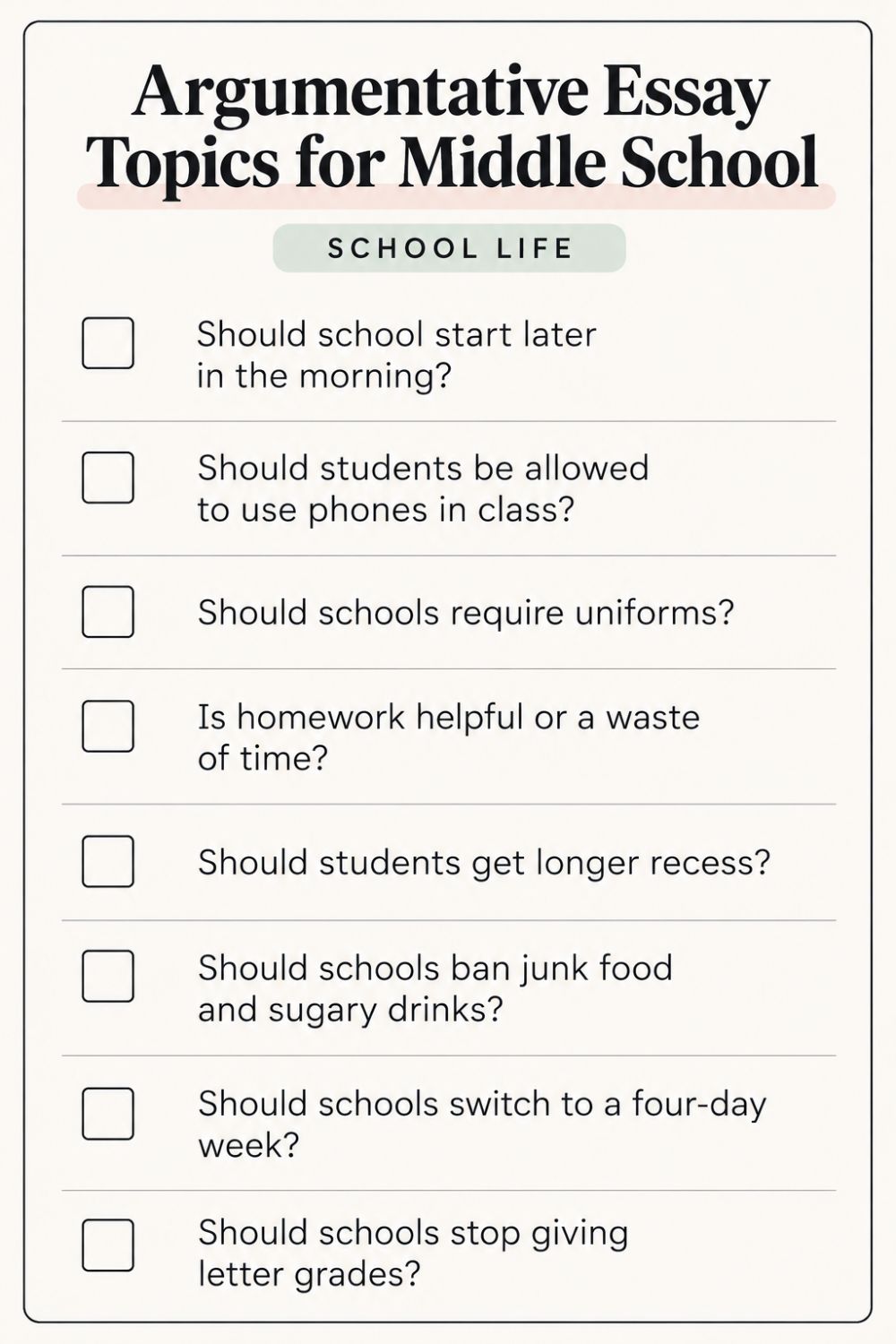
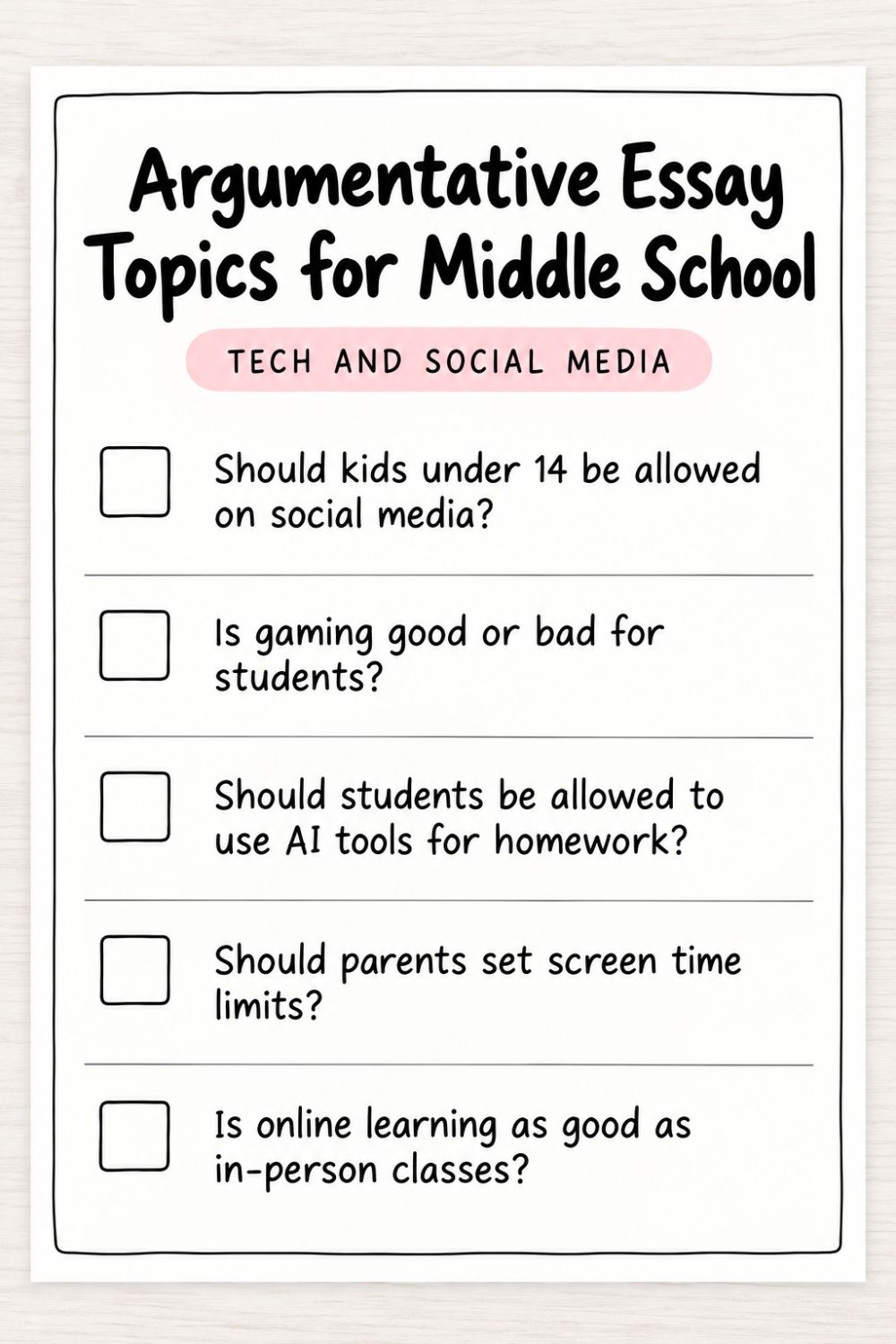
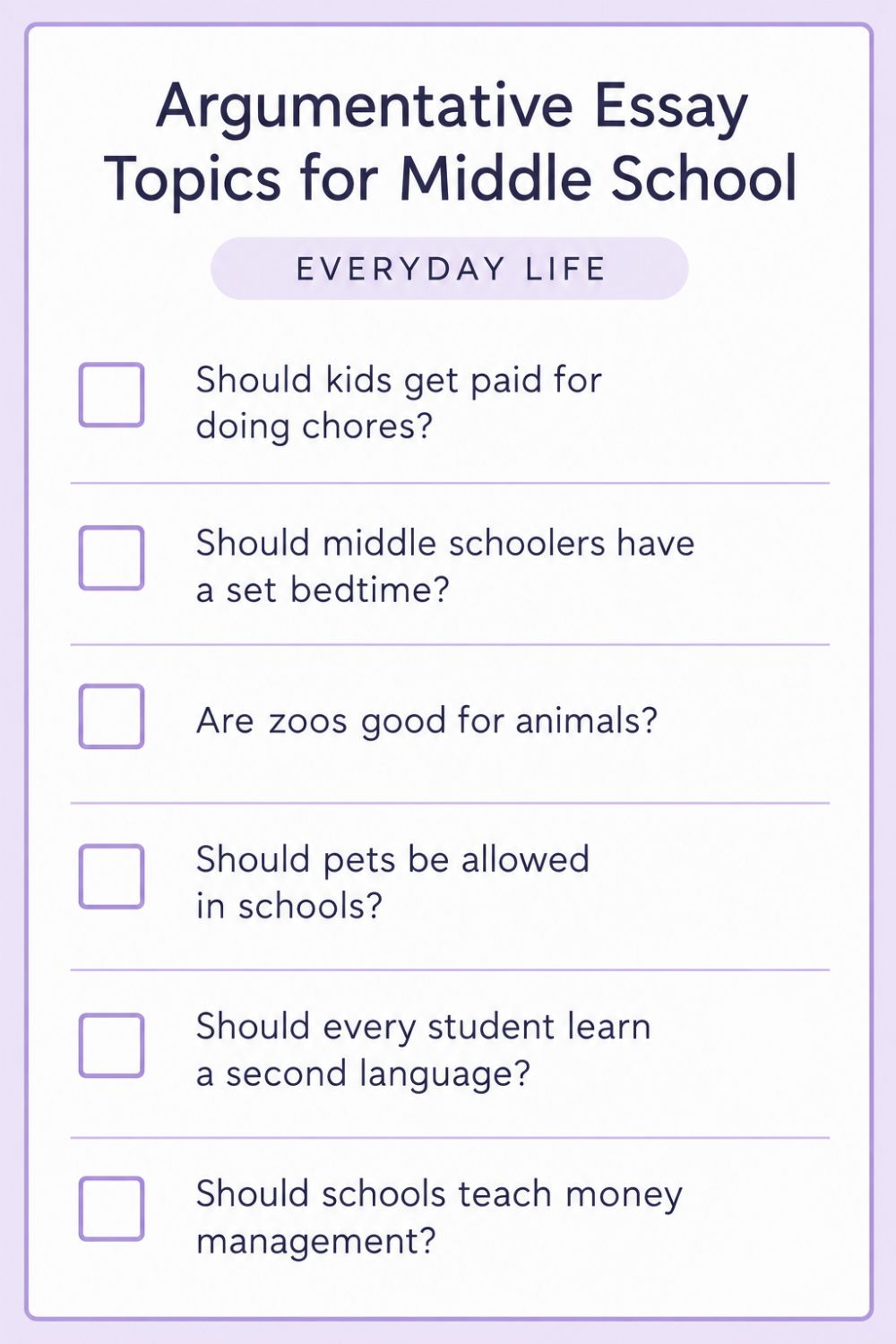
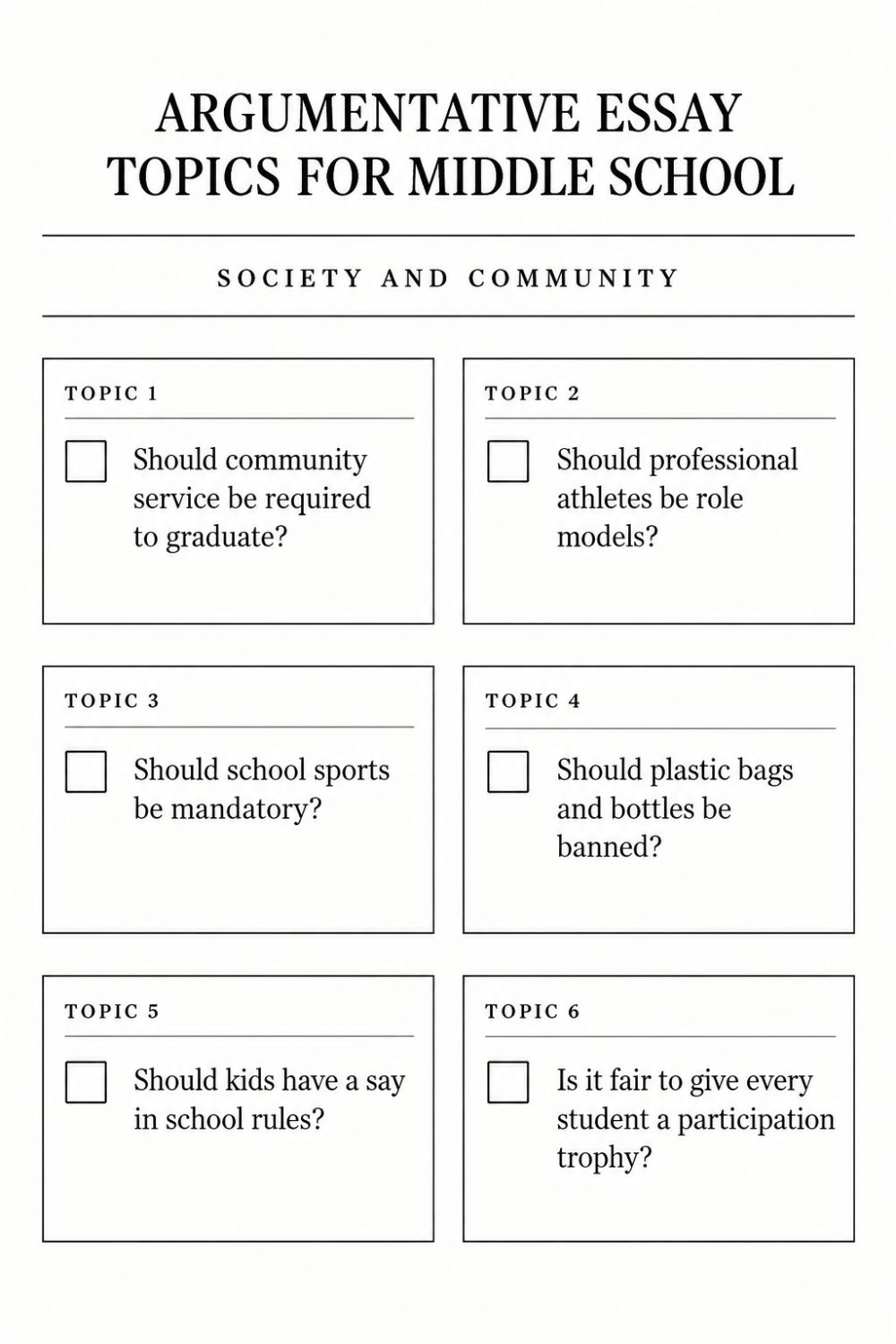
Every topic has a checkbox, so you can tick off the ones you like, narrow them down, and pick your favorite. Teachers can print a set for the whole class and use it for warm-ups, debates, or homework.
Wrapping up,
The best argumentative essay starts with a topic you actually care about. Pick one from the list, check that it has two real sides, find a few facts, and start writing. Don’t stress about getting it perfect on the first try.
Want more practice once you’re done? These speech topics for middle school students are a good next step for turning your argument into a short talk. Then download the free printable list above, circle your favorite topic, and share this post with a classmate or teacher who could use it.

An engineer, Maths expert, Online Tutor and animal rights activist. In more than 5+ years of my online teaching experience, I closely worked with many students struggling with dyscalculia and dyslexia. With the years passing, I learned that not much effort being put into the awareness of this learning disorder. Students with dyscalculia often misunderstood for having just a simple math fear. This is still an underresearched and understudied subject. I am also the founder of Smartynote -‘The notepad app for dyslexia’,