A classroom observation is only as useful as the feedback that follows it. Vague comments like “nice lesson” help no one, and inconsistent feedback leaves teachers guessing what good looks like.
That’s where classroom observation templates come in. They give observers a clear structure for recording evidence and sharing specific, actionable feedback every time. In this guide, you’ll get six free, downloadable templates, plus tips on choosing the right one and using it well.
What Is a Classroom Observation Template?
A classroom observation template is a structured form for recording what happens during a lesson. It prompts observers to note specific evidence, such as teaching methods, student engagement, and classroom management, instead of relying on memory or general impressions.
Templates are used by:
- Principals and administrators for teacher evaluation
- Instructional coaches and mentors for ongoing support
- Peers for collaborative learning
- Teacher trainees for practice and reflection
Every template in our free pack is ready to print, so you can start observing right away.
Why Use a Classroom Observation Form?
A good classroom observation form turns a subjective impression into usable evidence. Here’s what you gain:
- Consistent, objective feedback: Every teacher is observed against the same criteria, so feedback feels fair and clear.
- Less bias: Structured prompts keep observers focused on what they see, not gut feelings or personal teaching preferences.
- A record of growth: Completed forms let you compare lessons over weeks or terms and show real progress.
- Better evaluation and PD planning: Patterns across forms reveal where teachers need support, so training targets real needs.
Our free templates are built around these benefits, so each one is ready to use from the first observation.
Key Elements of an Effective Observation Template
The best teacher observation templates share the same core sections. Check that any form you use, including the ones in our free pack, includes these:
- Header details: Teacher name, class, date, subject, and observer. This keeps records organized and easy to compare.
- Lesson objectives and learning goals: Note whether goals were clear and whether students understood them.
- Teaching strategies and instruction quality: Record how the lesson was delivered, including pacing, explanations, and use of resources.
- Classroom management and environment: Look at routines, transitions, behavior expectations, and the learning space.
- Student engagement and participation: Track who is involved, how often, and how deeply.
- Assessment and questioning techniques: Note how the teacher checks understanding and the quality of the questions asked.
- Strengths, areas for growth, and next steps: End with specific takeaways and one or two action goals.
Tip: Leave space for evidence notes in every section. Comments backed by what you actually saw or heard are far more useful than ratings alone.
6 Types of Classroom Observation Templates
Each template below suits a different purpose. Pick the one that matches your goal, then download it from the pack.
1. Classroom Observation Checklist
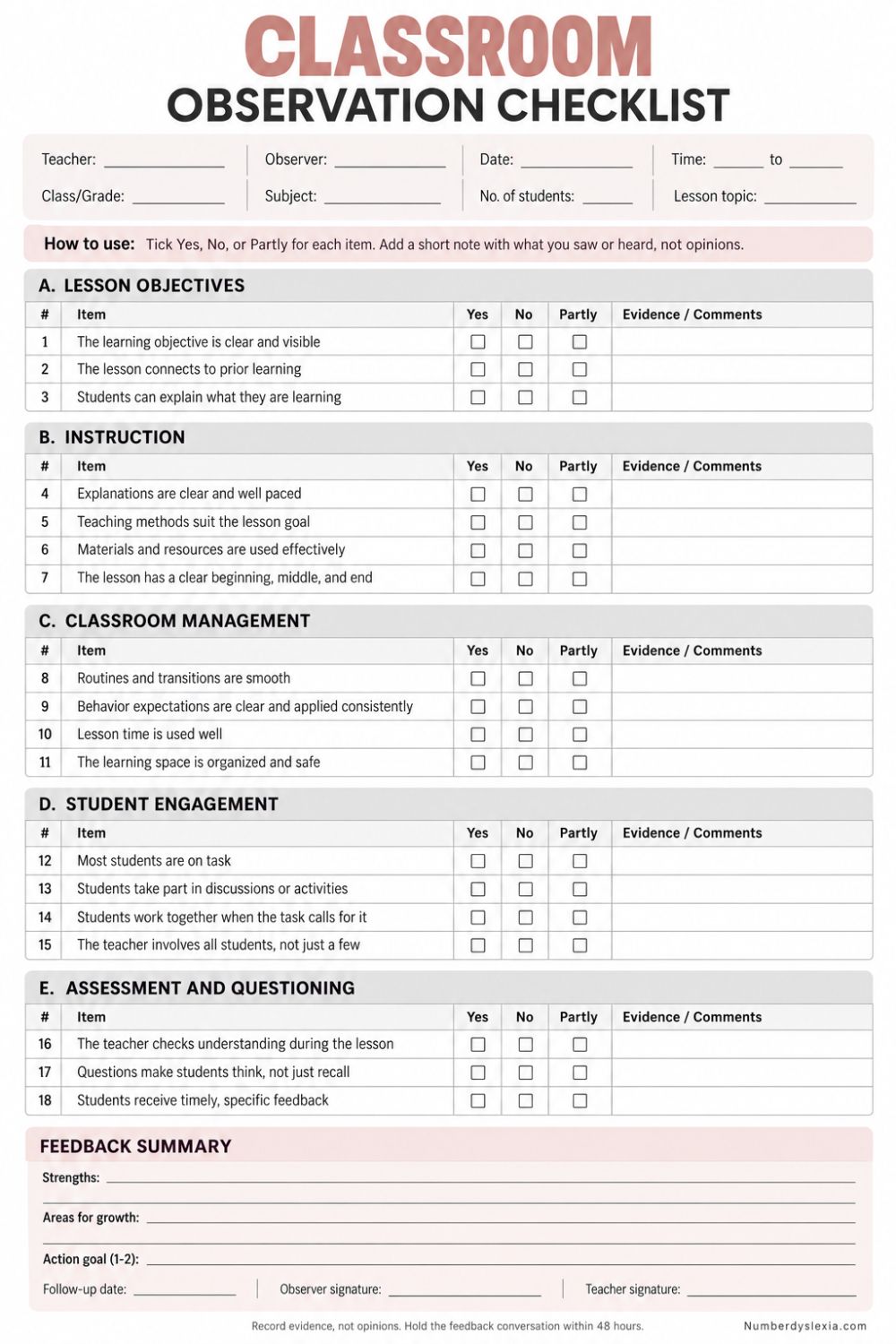
A classroom observation checklist is the fastest way to review a lesson. Observers mark items as Yes, No, or Partly for areas like clear objectives, smooth routines, student engagement, and use of materials, then add a short comment. It works well for new observers and quick check-ins. Keep it to 15-20 items so you can watch the lesson instead of the form. For more printable lists like this, browse our essential checklists.
2. Classroom Observation Rubric
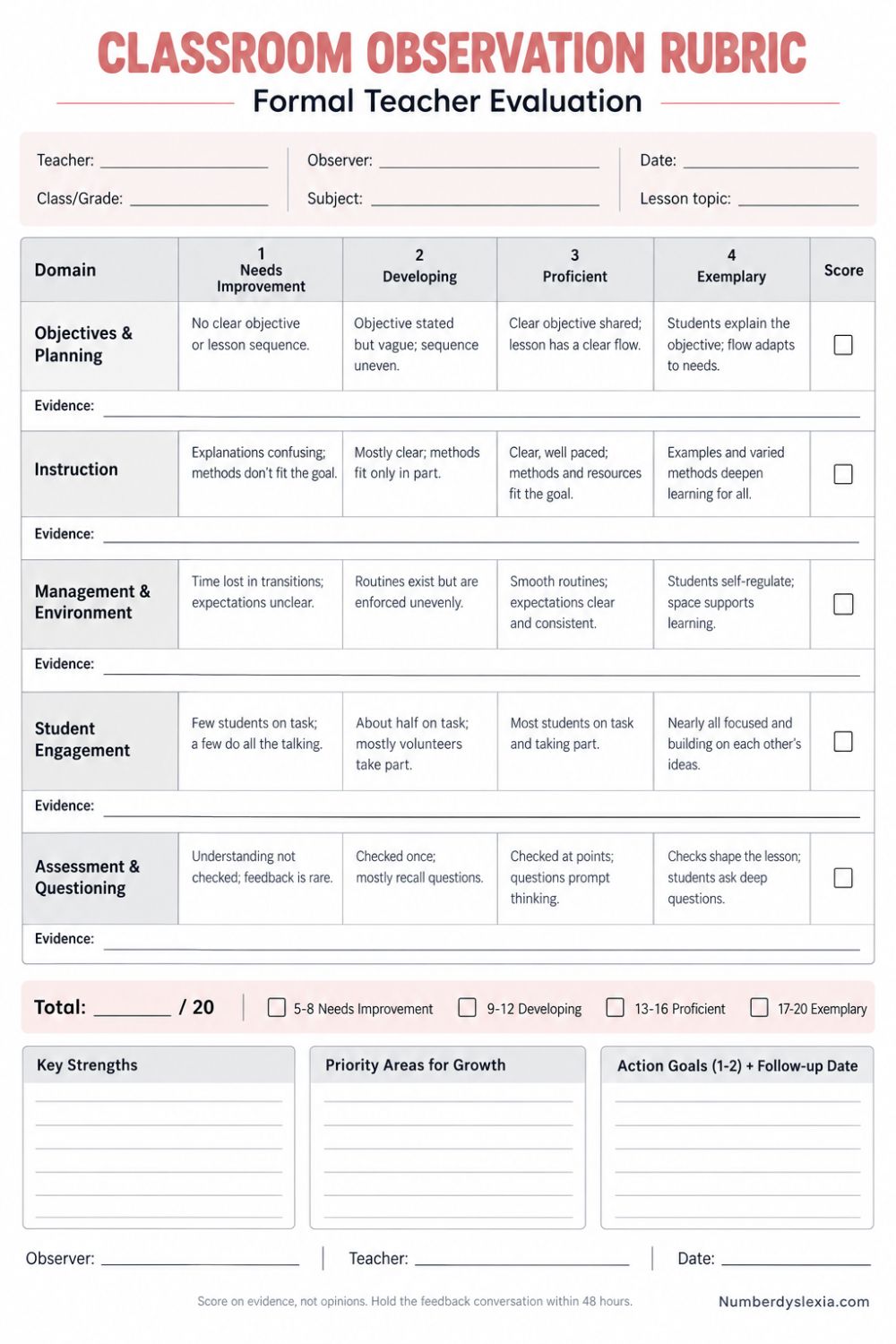
A classroom observation rubric scores teaching across performance levels such as Needs Improvement, Developing, Proficient, and Exemplary. Each teaching domain has space for evidence, which makes it the strongest choice for formal teacher evaluation. Clear descriptions for every level help different observers score the same lesson in the same way.
3. Narrative (Anecdotal) Observation Template
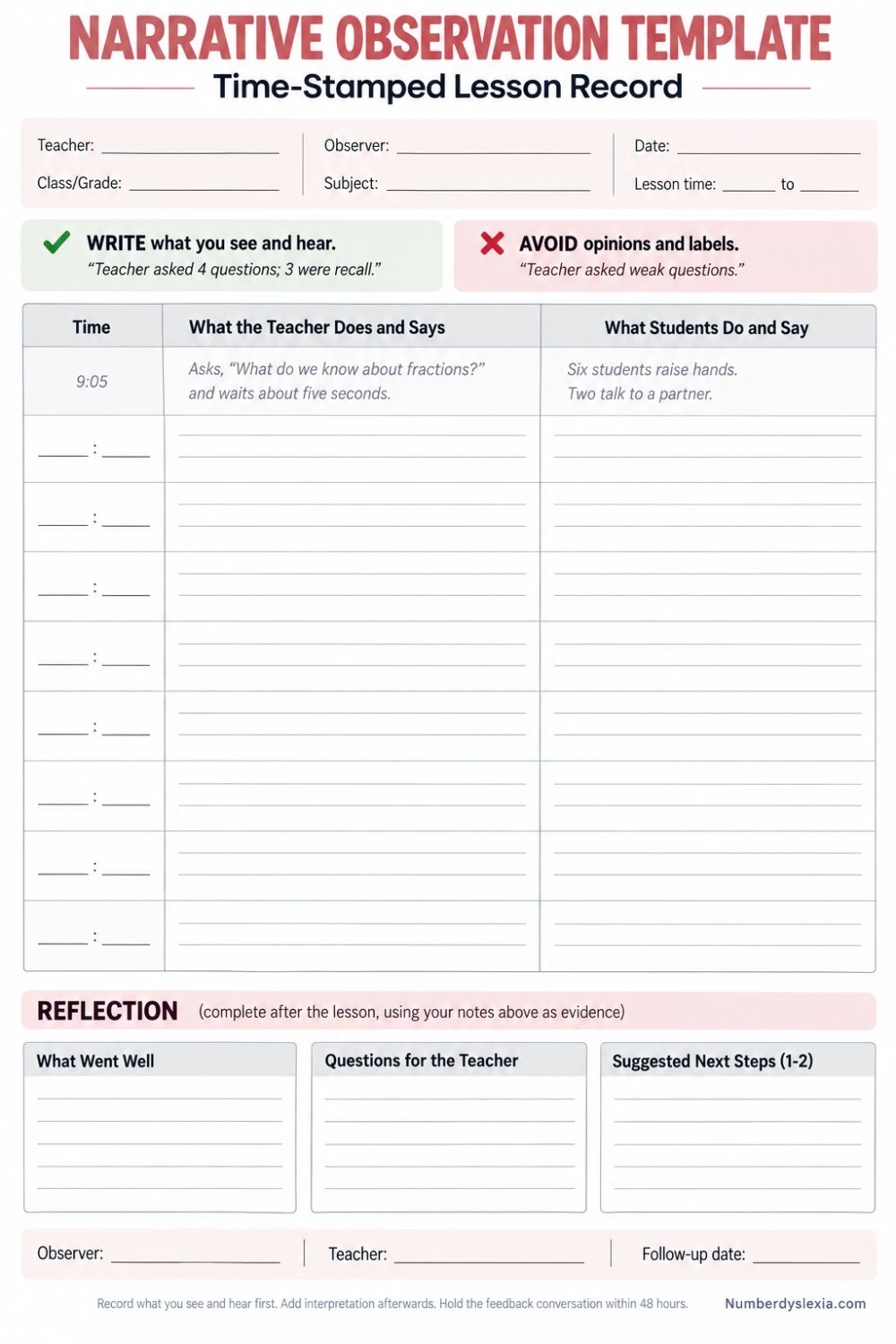
This template captures a detailed, time-stamped account of the lesson, including what the teacher does and how students respond. A short reflection section at the end turns notes into feedback. Write only what you see and hear during the lesson, and save your interpretation for afterwards to keep the record objective.
4. Peer Observation Form
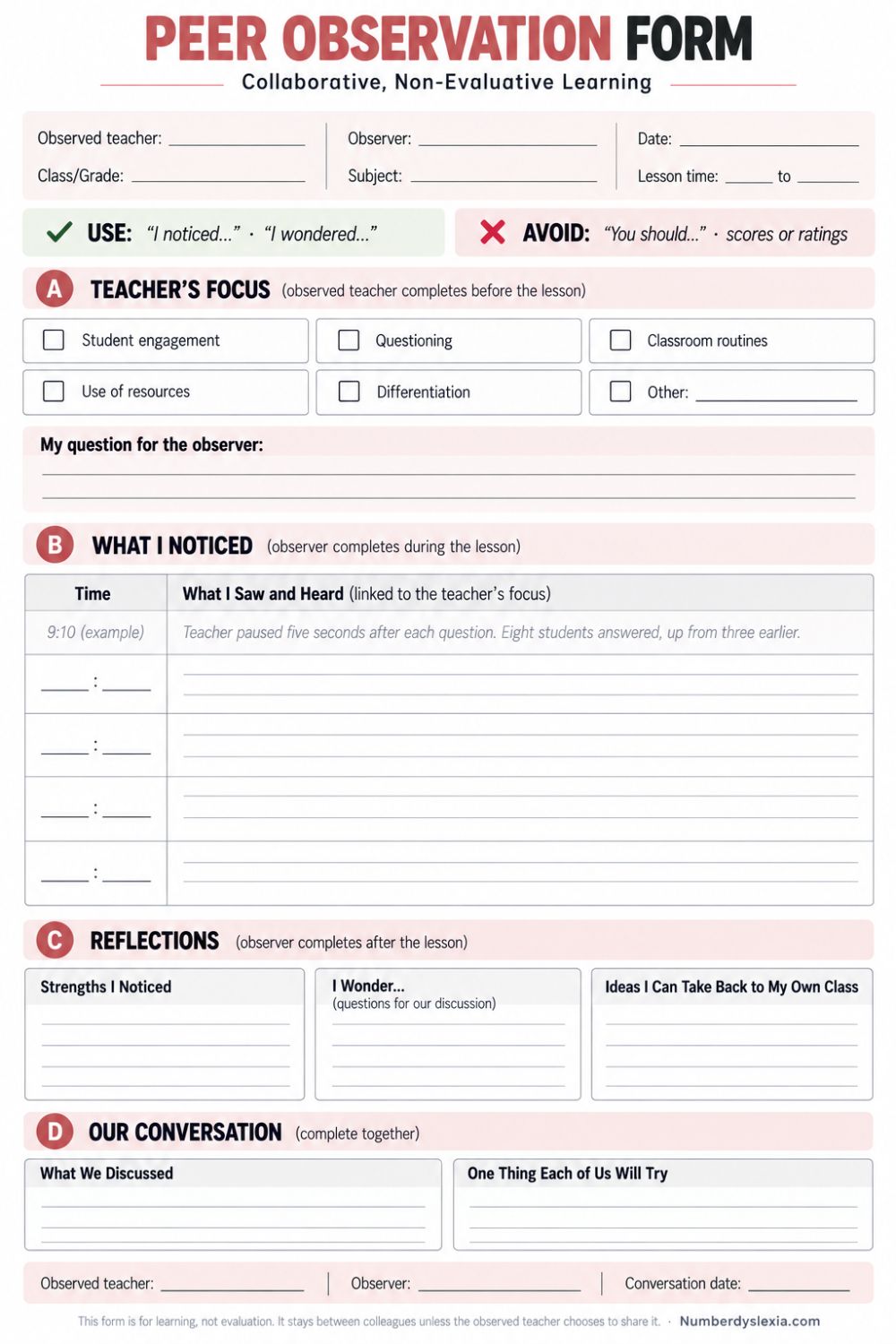
A peer observation form supports collaborative, non-evaluative learning between colleagues. The observed teacher chooses the focus area, and the observer records what they noticed, strengths, and questions for discussion. Letting the teacher lead the focus builds trust and makes the follow-up conversation more open.
5. Walkthrough Template
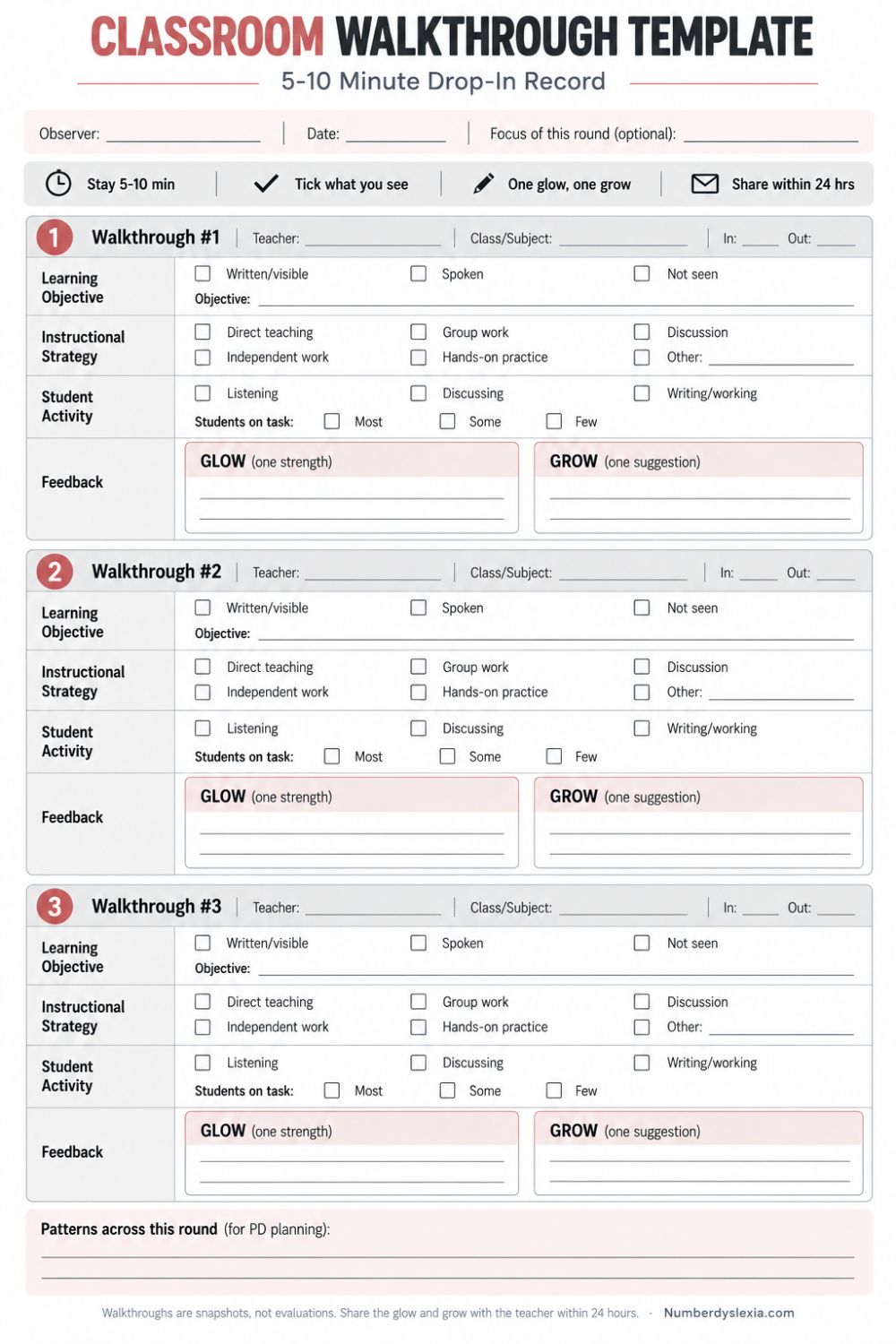
Built for short drop-ins of 5-10 minutes, this template records the visible learning objective, the instructional strategy, student activity, and one “glow and grow” comment. Using the same form across many classrooms helps school leaders spot trends and plan professional development.
6. Student Engagement Observation Template
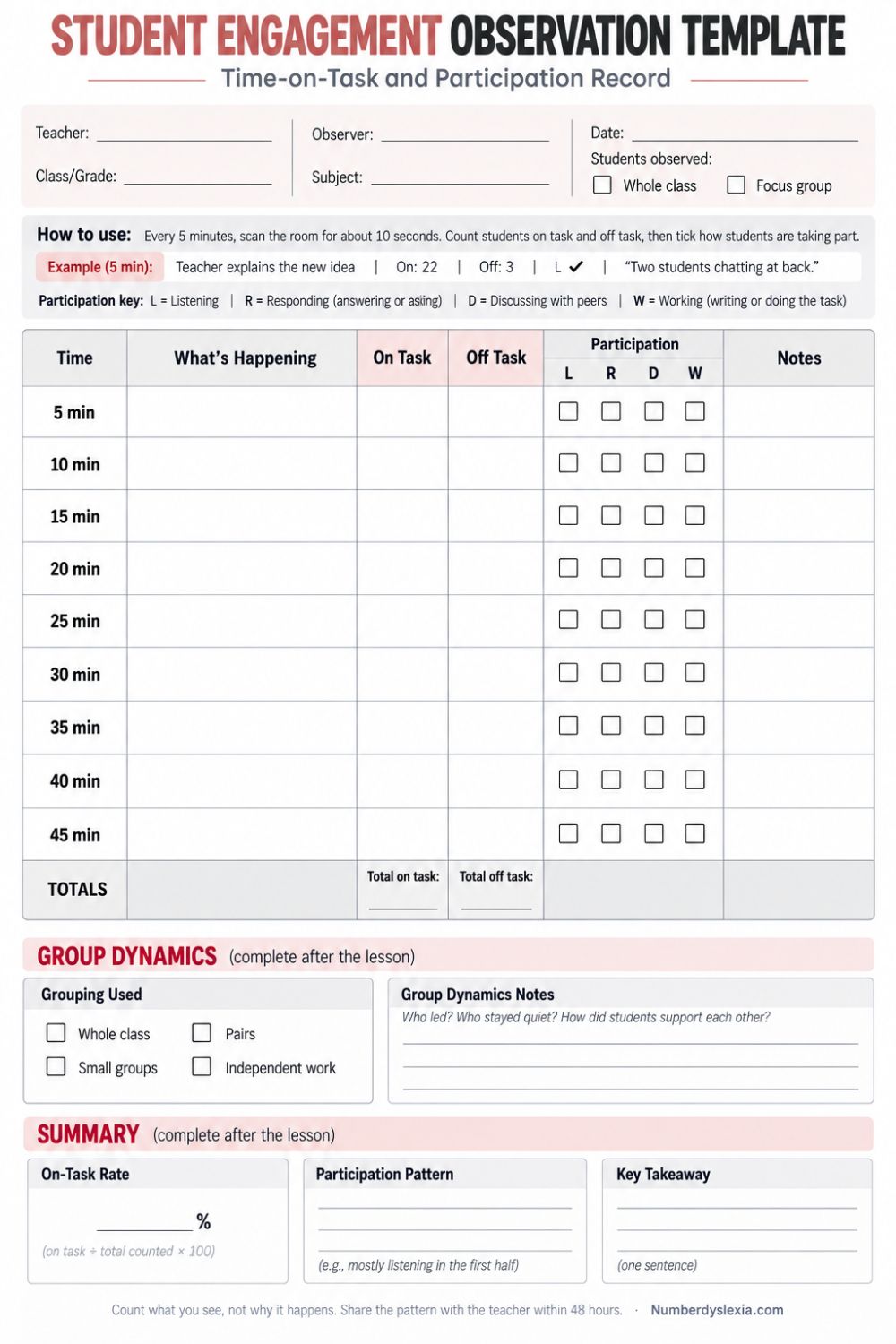
This template tracks time-on-task and participation using fixed time intervals, on-task and off-task counts, and notes on group dynamics. Sampling students every five minutes gives more reliable data than general impressions, and it keeps the focus on learners rather than the teacher.
Download Free Classroom Observation Templates (PDF)
All six templates from this guide are in one PDF. It has the checklist, rubric, narrative form, peer observation form, walkthrough sheet, and student engagement tracker, each on its own page so you can print only what you need. Print a few copies before your next observation and keep them in a folder, so every observer uses the same format and your notes stay easy to compare later.
How to Choose the Right Template
Start with your purpose. If you’re evaluating a teacher, the rubric gives you scored, defensible results. For coaching, the narrative form or checklist works better because it leaves room for conversation. For peer learning, use the peer observation form, which keeps things non-evaluative.
Next, think about your time. A walkthrough fits a 10-minute drop-in, while a full rubric needs the whole lesson. Subject and grade level matter too, since a kindergarten lesson looks very different from a senior science lab, and a hands-on math class looks different again.
Whichever you pick, keep it to one or two pages.
How to Conduct a Classroom Observation (Step-by-Step)
A template works best when it’s part of a clear process. Follow these five steps.
- Meet before the observation. Talk with the teacher about the lesson and agree on one or two focus areas. This removes surprises and makes the feedback more relevant.
- Observe and record evidence. Sit where you can see the whole room. Write down what you see and hear, such as questions asked, student responses, and timing. Note how the room is set up too, from seating to wall displays. Save opinions for later.
- Hold a post-observation conference. Meet within 48 hours, while the lesson is still fresh. Start with strengths, then discuss one or two areas to grow, using your notes as evidence.
- Set one or two action goals. Keep them small and specific, so the teacher knows exactly what to try next.
- Follow up. Check progress in a few weeks, through a short walkthrough or a quick conversation.
Final Thoughts
A good observation doesn’t need a complicated form. It needs a clear focus, honest notes, and a conversation that follows while the lesson is still fresh. The template just keeps you on track.
If you’re not sure where to begin, pick one format from the PDF and use it for your next observation. Notice what works, change what doesn’t, and adjust the form to suit your school. After a few rounds, feedback gets easier to give and easier for teachers to act on.
Download the classroom observation templates PDF and try one this week.

An engineer, Maths expert, Online Tutor and animal rights activist. In more than 5+ years of my online teaching experience, I closely worked with many students struggling with dyscalculia and dyslexia. With the years passing, I learned that not much effort being put into the awareness of this learning disorder. Students with dyscalculia often misunderstood for having just a simple math fear. This is still an underresearched and understudied subject. I am also the founder of Smartynote -‘The notepad app for dyslexia’,