

Last Updated on July 23, 2026 by Editorial Team
There is no official science-backed treatment or medication to treat dyslexia. For all we know, the best way to overcome dyslexia is to adopt a new learning process as early as possible in life. We already discussed a couple of ways of doing it.
Another important measure is to practice well. This is best achievable through worksheets. Practicing worksheets catering specifically to pupils with dyslexia in a routine seems to be successful in this aspect. As the age grows, so does the level of understanding through these worksheets, and the pupil makes good progress on overcoming the issues.
As per the demand of our users, Numberdyslexia made some worksheets for practice, specifically for students with dyslexia. These worksheets are designed based on the Orton Gillingham approach. We already made some OG specific worksheets. So, do check them out too. We’ve focused on individual aspects of the approach and tried to incorporate it into the worksheets.
Here are the free printable dyslexia worksheets for practice. You can also download the pdf version below.
💡 Dyslexia Practice Success Checklist
Before you print your practice sheets, review these three core guidelines to align your teaching with the Orton-Gillingham approach:
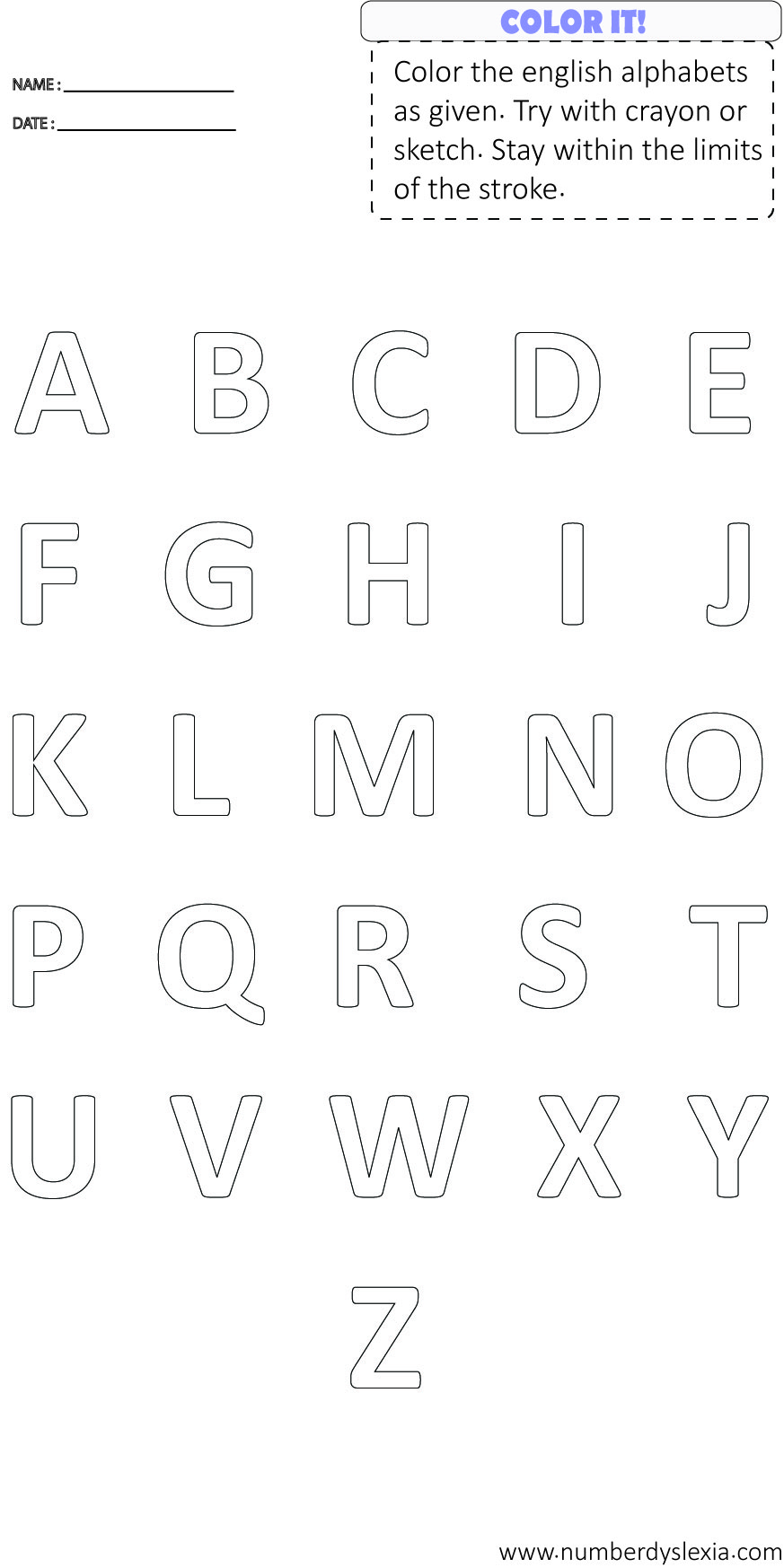
- Engage multiple senses: When tracing the letters in the ‘Color It’ exercise, have the student state the letter name and phone sound out loud while tracing with textured crayons.
- Work in brief, focused intervals: Dyslexic learners experience mental fatigue quickly. Keep worksheet practice sessions limited to 10 or 15 focused minutes at a time.
- Track tracking errors: Use a clear, colored plastic overlay sheet or a physical reading tracker bar over the jumbled word tasks to prevent eyes from jumping lines.
🧠 The Multi-Sensory “Air Writing” Warm-Up
Before putting pencil to paper for letter discrimination exercises, try a 60-second muscle-memory drill. Have the learner look at a target letter (like ‘b’ or ‘d’), lock their elbow straight out, and trace the letter form on a large scale in the empty air using two fingers. This full-arm movement activates large motor pathways, creating a neural anchor that helps prevent letter reversals before standard seatwork begins.
1. Color It
The first worksheet triggers the most common skill that Orton-Gillingham is based upon, i.e., Multisensory Learning. In this, Students have to trace the letters as given with a pencil, sketch, or crayons. Students must try to be within the limits of the stroke of the letters.
🎨 Multisensory Tip: Use textured mediums like glitter glue, sand-art pens, or heavy wax crayons for this activity. The rough physical friction gives tactical feedback that cements letter tracking lines in the brain far better than a standard smooth pencil track.
2. Jumbled Words
In our second worksheet, we are given jumbled words. Students have to find the correct word. After finding the word, either they can cut and paste from the left side to the given spaces or draw/write it in the spaces given with a sketch or pen. Teachers can further take it to the next level by giving longer jumbled words.
🧩 Kinesthetic Variation: For an active twist, cut these jumbled letter sequences out physically using child-safe scissors. Let your student arrange the structural pieces manually across their desk like magnetic plastic letters before they attempt to write out the final word answer.

3. Letter Discrimination
This worksheet helps dyslexic kids improve the ability to discriminate between similar-looking letters. This is one of the most common issues faced by pupils with dyslexia. Teachers are requested to follow up with more similar exercises.
🔍 Cognitive Shielding Tip: Focus strictly on one pair of confusing letters per session (such as ‘b’ and ‘d’). Mixing ‘b’, ‘d’, ‘p’, and ‘q’ all into a single lesson blocks processing and can quickly overwhelm a dyslexic learner’s spatial coordination.

4. Which way?
Another side effect of dyslexia is the difficulty with directions. Individuals with dyslexia often struggle with left, right, east or west. This worksheet helps kids practice the same in an interactive way. Students must find the route from the star to the goal. As they search, draw the route and write the instructions to reach through the route in the given space. Start can’t pass through the obstacles.
🧭 Spatial Tracking Tip: For learners struggling with left-versus-right directional rules, temporarily move away from abstract compass terms. Anchor their directional navigation by referencing fixed physical landmarks in their immediate environment (such as “turn toward the classroom window” or “face the classroom door”) to build reliable muscle coordination before testing them on paper tracks.

Beyond the Practice Sheets: Building Lifelong Learning Confidence
Worksheets are wonderful blueprints, but your encouragement is the real engine for growth. Progress with dyslexia is rarely a straight line; it is built on small, daily victories. Celebrate the moments your student attempts a tricky letter blend or solves a directional maze, regardless of perfection. Your patience transforms a routine study session into a safe space where mistakes are simply stepping stones toward mastery.
Remember that a dyslexic mind is not a broken computer—it is simply operating on a beautifully unique processing system. By weaving multisensory games and kinesthetic tracking tools into their regular schedule, you are actively remodeling their neuroplastic pathways. Grab your combined, printer-ready bundle below, clear off the desk, and enjoy watching your student blossom into a proud, independent reader.

An engineer, Maths expert, Online Tutor and animal rights activist. In more than 5+ years of my online teaching experience, I closely worked with many students struggling with dyscalculia and dyslexia. With the years passing, I learned that not much effort being put into the awareness of this learning disorder. Students with dyscalculia often misunderstood for having just a simple math fear. This is still an underresearched and understudied subject. I am also the founder of Smartynote -‘The notepad app for dyslexia’,