

Last Updated on August 1, 2026 by Editorial Team
Trying to track down some practical triangular prism real-life examples for a school project, or just wondering what an everyday triangle-based prism actually looks like outside of math class?
Spotting a triangular prism in real life can feel a bit tricky compared to simple shapes like cubes or spheres, but real-life examples help students navigate through the concepts easily by unfolding the mystery of its practicality.
Learning to draw and solve problems on a triangular prism is one thing, but witnessing them right in front of you is as good as magic. This hands-on experience helps young learners become much better at their classroom lessons, especially in geometry concepts that pose a real difficulty when visualizing beyond bookish knowledge.
To do a little hand-holding, we bring to you a list of everyday examples where you can witness triangular prisms in the real world. But before we dive in, let us take a quick second to look at its basic geometric configuration.
📐 Mapping Out More 3D Geometric Shapes?
Build a complete visual geometry library for your students. Open our other popular, free shape and pattern guides in a new tab:
What is a triangular prism?
In simple words, a triangular prism is a three-dimensional geometrical shape with three rectangular flat sides connecting with two identical triangular bases.
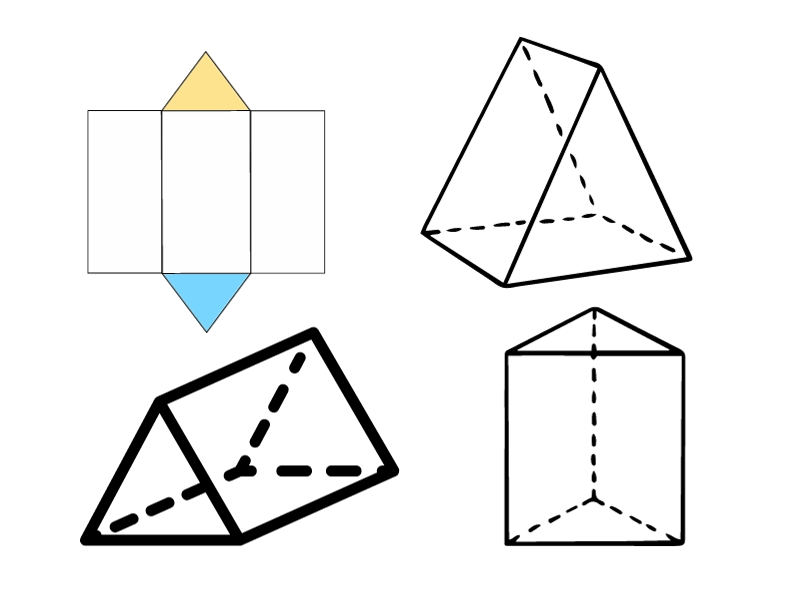
A triangular prism has 9 edges and 6 vertices. These prisms find use in several applications in real life, such as in types of wrappers and packings, in decorative items, in construction, in road safety, and much more. Let us learn more about these in detail in the following section of the post.
📐 What Does a Triangular Prism Look Like?
If you are trying to picture a triangular prism beyond flat lines on a page, imagine a classic camping tent or a wedge of cheese. It is a solid, three-dimensional shape that stays completely uniform from front to back, always maintaining a perfect triangle profile on both ends.
To easily identify or track this shape in the real world, remember its core anatomical checklist. Every standard triangular prism is made up of exactly:
- Two Triangular Faces: These act as the identical parallel “end caps” or bases at the front and back of the shape.
- Three Rectangular Faces: These smooth side walls wrap around the shape to connect the two triangle ends together.
- Five Faces Total: Adding the two triangles and three rectangles gives the prism its complete outer envelope.
- Six Vertices: These are the sharp corners where three distinct edge paths meet up.
- Nine Edges: These are the straight lines or physical seams that frame the boundaries of the shape.
Significant real-world examples of triangular prisms
Exploring ten real-world examples of triangular prisms throws light on their versatility across different segments of the world. Read on to find out more!
1. Swing/slide

Swings and slides are the most essential rides at any playground. Children love swinging and sliding because of the amount of fun it gets them. The swing is usually connected to a sturdy frame, and each frame houses two swings. When you carefully observe a swing frame, you can identify two triangular frames on both the right and left sides. These triangular frames provide structural strength to the swing frame.
As a result, the swing frame takes on the shape of a triangular prism when you consider the combination of these triangular sides and the rectangular faces in the front, back, and base. The triangular sides contribute to the prism’s overall structure, making it a practical example of a triangular prism in real life.
On the other hand, the slide has a ladder and a surface on which children slide, and both are rectangular in shape. The ladder and the sliding surface together form a triangular prism.
2. Ramp structures for wheelchair access

For inclusivity, some architectural designs consist of triangular ramps so that wheelchair-bound people have no issues with accessibility to buildings. While conventional ramps are not triangular prism-shaped, modern-day ramps are constructed in this manner due to better grip and increased graduality in ascent or descent.
3. A-frame houses

A-frame houses are distinctive not only due to their name but also due to their appearance. The A-frame mimics the frame line of a triangular prism. Besides the aesthetic appeal, an A-frame house can easily shed off residues of rain and snow, eliminating the need to manually clean it. The steep roof also promotes energy efficiency by making it easy to install solar panels.
4. Chocolate candy bars (Toblerone)

Standing out in the supermarket for its intriguing structure is the Toblerone chocolate with its triangular prism-shaped wrapper. The wrapper contains several tiny peaks and valleys, with each peak and valley signifying a block of chocolate, making it easy for you to break off the chocolate while consuming. It is not just candy, but it’s a lot of cocoa with some math!
5. A piece of cake/Sandwich/cheese

Every time you cut out a piece or slice of cake or cheese, or you make a sandwich using bread and cut it into two halves diagonally, you actually encounter a triangular prism. These pieces and slices are elongated, triangular, and have flat sides. Their shapes can vary widely, but this is one of the most commonly observed shapes.
6. Camping tents

Camping tents are a common sight at every picnic and trekking activity. Usually, these come with a manual on how you can construct them. Once you have constructed it and it stands upright, you will see that it is a triangular prism.
7. Triangular bookshelf

A triangular bookshelf is a peculiar example of a triangular prism. These serve both functionality and also add to the aesthetic appeal of your homes. Since they are much different from the usual and ordinary rectangular or square-shaped bookshelves, they add to the visual delight of the viewers.
8. Foldable ladder

Want to reach the ceiling fan or want to fix the bulb? Use the foldable ladder! The foldable ladder, when placed, mimics a triangular prism with both the ladders serving as two rectangular faces, and the floor acting as the third rectangular face. This forms two triangular faces in between the rectangular faces.
9. Billiard triangle

A billiard triangle is a concrete frame or structure that holds the billiard balls together at the beginning of a billiard game. As the name suggests, it is triangular in shape, but the frame is three-dimensional, making it a triangular prism.
10. Desk Calendars

Desk calendars, when folded and placed on a desk, tend to take the form of a triangular prism. The desk or a flat surface on which the calendar is placed acts as the third rectangular face.
11. Kids abacus toy

An abacus is a great way to teach children mental math from an early age. The abacus for kids consists of colorful beads that are placed on rods within a triangular frame. This triangular frame is sturdy and holds the entire structure intact. When viewed, it appears like a desktop calendar and is a triangular prism.
12. Trestle Table/Rehal Stand

A trestle table or a rehal stand may just look like classic rectangular tables, but their supporting legs often form a triangular prism. The legs of the table are formed in such a way that they form triangular faces on both the right and left sides, providing strength to the table and overall giving rise to a shape of a triangular prism for extra support and stability.
How do real-life examples aid understanding of Geometry concepts?
Having an insight into some of the real-life examples of geometric concepts sows the seed to develop practical knowledge and opens doors to diverse career paths. Here are some reasons why we think learning geometry through real-life examples must be encouraged:
1. Fiddling around with the practicality and existence of geometric figures in the real world.
Understanding the practical and real-world applications of geometry can be quite intriguing. Observing things practically helps one connect the dots between theoretical and bookish knowledge and the ‘know-how’ of the world.
2. Open a can of career opportunities.
Geometry serves as the foundational base for several professions like engineering, design, construction, and architecture. Having a chance to witness the working of abstract knowledge in the real world gives each one a chance to explore various career paths associated with these fields.
3. Development of skills such as visual, memory recall, and spatial.
When one visually sees the existence of geometric shapes in the real world straight out of their books, there is encouragement for the improvement of visual and spatial skills. Memory recall comes into the picture when students may have to go back to their class and use this visualization to solve a problem.
4. Developing problem-solving skills
Word problems in geometry are a common sight in high school textbooks. Hence, understanding some of the real-life examples used across different contexts promotes critical thinking and helps one to develop a strategic approach toward understanding and solving related problems. In addition to this, students can engage in word problems, online games, and activities to supplement their learning sessions with fun and enjoyment.
💡 3D Prism Differentiation Classroom Checklist
Before introducing physical prism shapes or math worksheets to early learners, follow these three practical tracking rules:
- Isolate the faces from the bases: Show students that while the sides (faces) of a triangular prism are flat rectangles, its two end caps (bases) are always identical parallel triangles.
- Separate prisms from pyramids early: Avoid tracking confusion by showing that a prism maintains the same uniform triangle shape all the way through, while a pyramid tapers up to a single sharp point.
- Enforce structural volume tracking: Have middle school students multiply the base triangle’s area by the prism’s length to let them actively discover volume parameters using tactile everyday items.
🧠 Easing Spatial Processing Fatigue via Concrete Objects
Struggling to visualize three-dimensional axes on a flat blackboard frequently triggers mental exhaustion for kids navigating tracking blocks or math anxiety. Moving the lesson from abstract line drawings to real, touchable household objects completely bypasses this processing obstacle. When a child holds a Toblerone chocolate bar or checks out a miniature desk prism, their brain instantly links geometric symmetry to something familiar and concrete. This hands-on sensory mapping builds deep confidence in their early spatial reasoning skills without forcing them to rely on rote memorization.
Conclusion
In summary, shedding light on the real-world applications of triangular prisms might help students knock on the doors of various skill development regimes and career opportunities. From speed squares to Toblerone to chandeliers, bridge the gap between theory and practicality to help students understand the relevance of geometry in real life.

An engineer, Maths expert, Online Tutor and animal rights activist. In more than 5+ years of my online teaching experience, I closely worked with many students struggling with dyscalculia and dyslexia. With the years passing, I learned that not much effort being put into the awareness of this learning disorder. Students with dyscalculia often misunderstood for having just a simple math fear. This is still an underresearched and understudied subject. I am also the founder of Smartynote -‘The notepad app for dyslexia’,