
![Free Printable Spelling Worksheets for grade 1 to 4 [PDF]](https://numberdyslexia.com/wp-content/uploads/2020/12/Blue-and-White-Colorful-Brushstroke-Art-Education-YouTube-Thumbnail-5.jpg)
Last Updated on June 7, 2026 by Editorial Team
While alphabet blocks, stairs activity, or scrabble games help children absorb spellings fun way, the worksheets offer them a resource to practice this skill with all seriousness. This is sometimes important when you want the kid to concentrate on the core learning instead of getting carried away by the gameplay. But, are books the only solution? Actually no! Kids tend to stray away from books because of their monotonous nature. That is why I have designed some worksheets for kids so that your repertoire of practice material never dries up.
Why worksheets to teach spellings to kids?
Worksheets break the monotony of the learning process. These are easy to compile and searching questions in these for practice does not take much time. So, instead of going through the whole book, early learners can utilize more time in the actual process of learning spellings. Apart from saving time, the other benefits offered by spelling worksheets for kids are:
- Worksheets offer the most relevant practice material for teaching spellings to kids. Since these are designed in accordance with progressive learning patterns, which means basic things first, kids do not feel overwhelmed by them.
- Secondly, the worksheets provide hands-on material for checking the learning progress. For example, kids can check proficiency in phonemics or phonics exercises first, then move to the CVC concept of spellings and like-wise.
- Since worksheets are designed topic-wise, the teachers can easily identify the problem areas of the kid and can guide them to put more efforts to overcome shortcomings.
- Worksheets can be used as a competition material. Children can be asked to solve them the fastest possible. With more and more time-pressed practice sessions, the early learners can become more fluent in spellings.
Now that you have understood how worksheets help achieve proficiency in spellings, let me take you through the worksheets to practice spellings that cover various concepts of word-formation. You can also download the free printable pdf version of the worksheets by clicking the link given.
![Free Printable Spelling Worksheet 1 for kids [PDF]](https://numberdyslexia.com/wp-content/uploads/2020/12/spell1.png)
![Free Printable Spelling Worksheet 3 for kids [PDF]](https://numberdyslexia.com/wp-content/uploads/2020/12/spel3-1.png)
![Free Printable Spelling Worksheet 2 for kids [PDF]](https://numberdyslexia.com/wp-content/uploads/2020/12/spell2.png)
![Free Printable Spelling Worksheet 4 for kids [PDF]](https://numberdyslexia.com/wp-content/uploads/2020/12/spell4.png)
Bonus Spelling Worksheets for Young Learners
These spelling worksheets add extra fun and variety in learning activities. They help young learners remain interested through interactive exercises like puzzles, matching games, and tracing. As they are versatile, teachers, parents, as well as students can use them during classrooms or homeschooling sessions.
Page 1
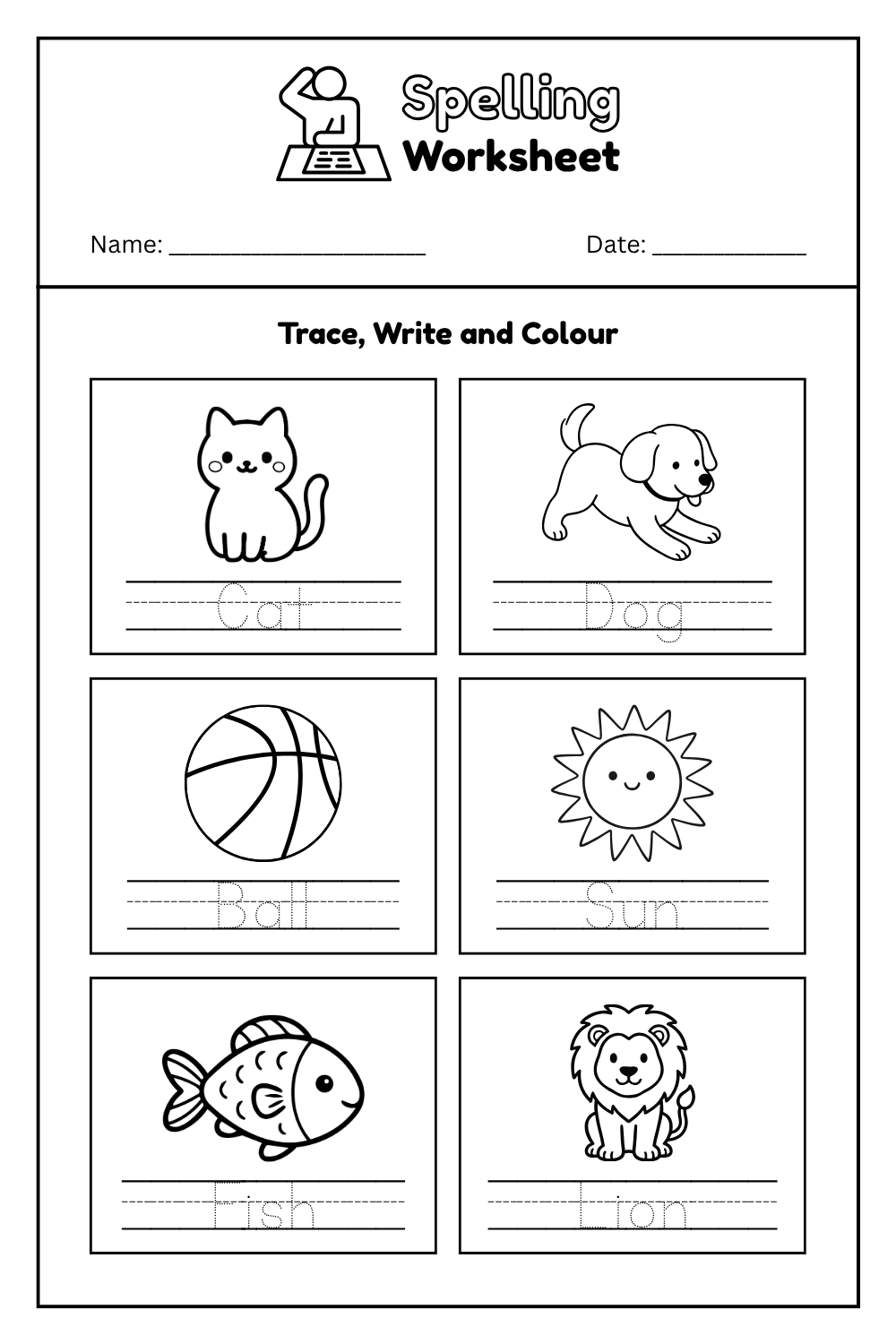
This worksheet includes simple picture words like cat, dog, ball, sun, fish, and lion. Children can trace each word and write it again on their own. They can also color the matching pictures. The activity combines handwriting practice with visual learning.
In this way, kids can recognize spellings and remember vocabulary words through repetition. This worksheet is useful for improving pencil control and handwriting skills. The coloring section also keeps children engaged for longer periods. The worksheet can be used for classroom learning activities.
Page 2
The next page focuses on helping children complete words by filling in the missing letters. The page also has pictures for giving clues. Multiple easy-to-read words are mentioned on the sheet. They help kids understand basic spelling patterns and phonics.
It also encourages children to identify sounds. They can further easily connect them with the correct letters. The worksheet is beneficial for strengthening phonics knowledge and vocabulary development. It also improves concentration and problem-solving skills. Such activities make early literacy learning interactive.
Page 3
Some activities can truly engage children in learning deeply. This worksheet includes picture-based spelling activities. Here, children cut out letters from the bottom section. They are then required to paste letters in the correct order to form words.
The images include objects and animals that they see in everyday lives. It helps improve letter recognition and fine motor coordination. Cutting and pasting also strengthens hand-eye coordination. Such a visual and practical activity is helpful as compared to traditional writing exercises.
Page 4
After understanding a few spellings, this worksheet tests knowledge of children. It contains a word search puzzle. Children need to find hidden words related to everyday objects. To help them further, it has pictures on the top of the puzzle. They must carefully scan the grid and outline or circle the correct words.
This worksheet helps improve concentration and spelling memory. It also improves observation skills and pattern recognition. So, children can learn independently. It can also be used in school classrooms for group activities between teams.
Page 5
This worksheet has mixed-up letters in a structured way. Children have to rearrange them to form correct words. It also has picture clues for easy identification. Words are connected to different images for easy identification.
The page encourages logical thinking too. It enhances critical analysis and vocabulary development. It helps children understand letter placement and spelling patterns effectively. So, it can keep learners mentally active while practicing.
Page 6
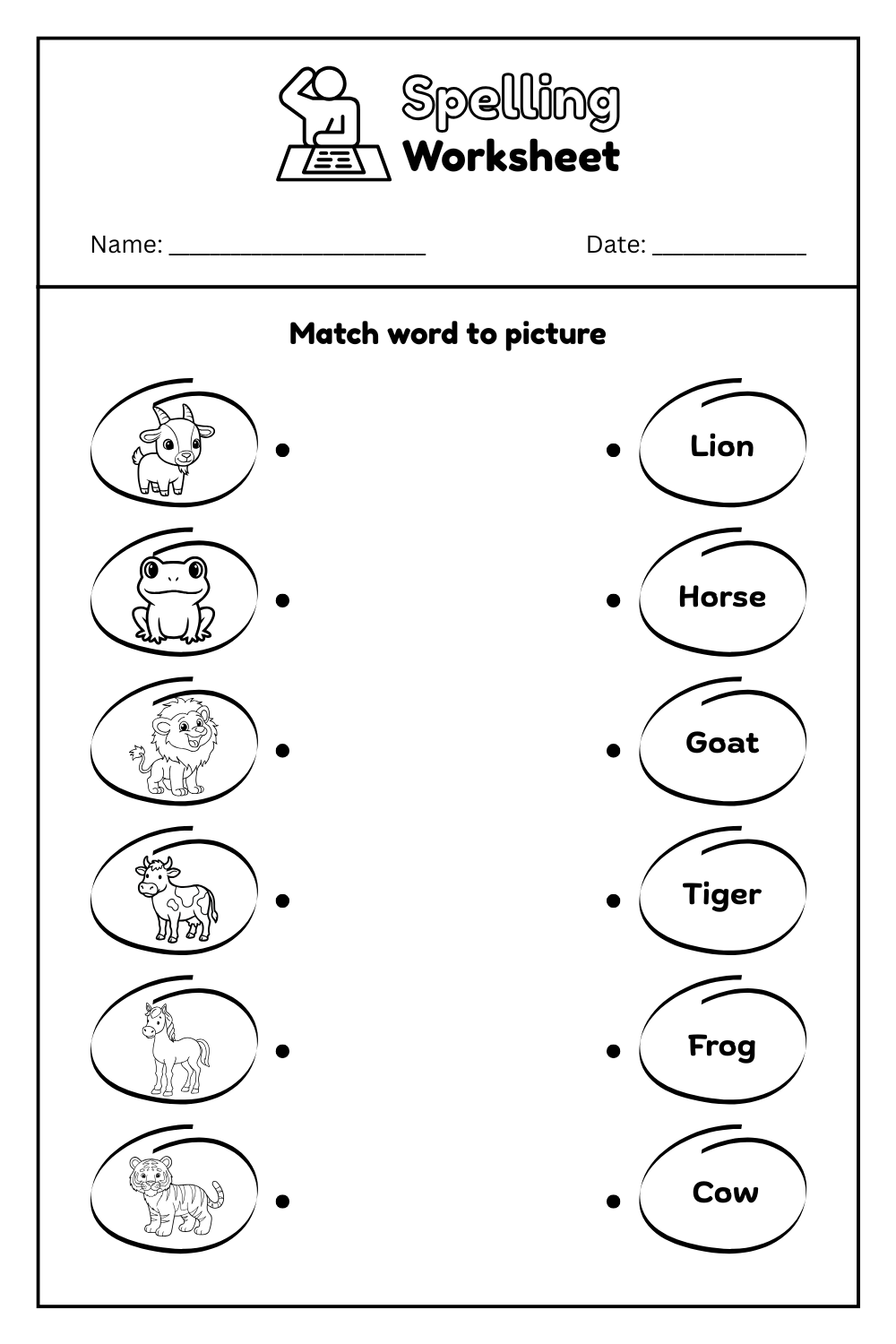
The next worksheet asks children to match pictures of animals with their correct names. They need to draw lines between each picture and the matching word. The activity helps them connect visual recognition with spelling.
The activity improves reading comprehension skills as well. Such a page focuses on improving their memory and builds observation skills. You can also hide the spelling and ask children to name the pictures before matching them. It is ideal for a mental revision.
Page 7
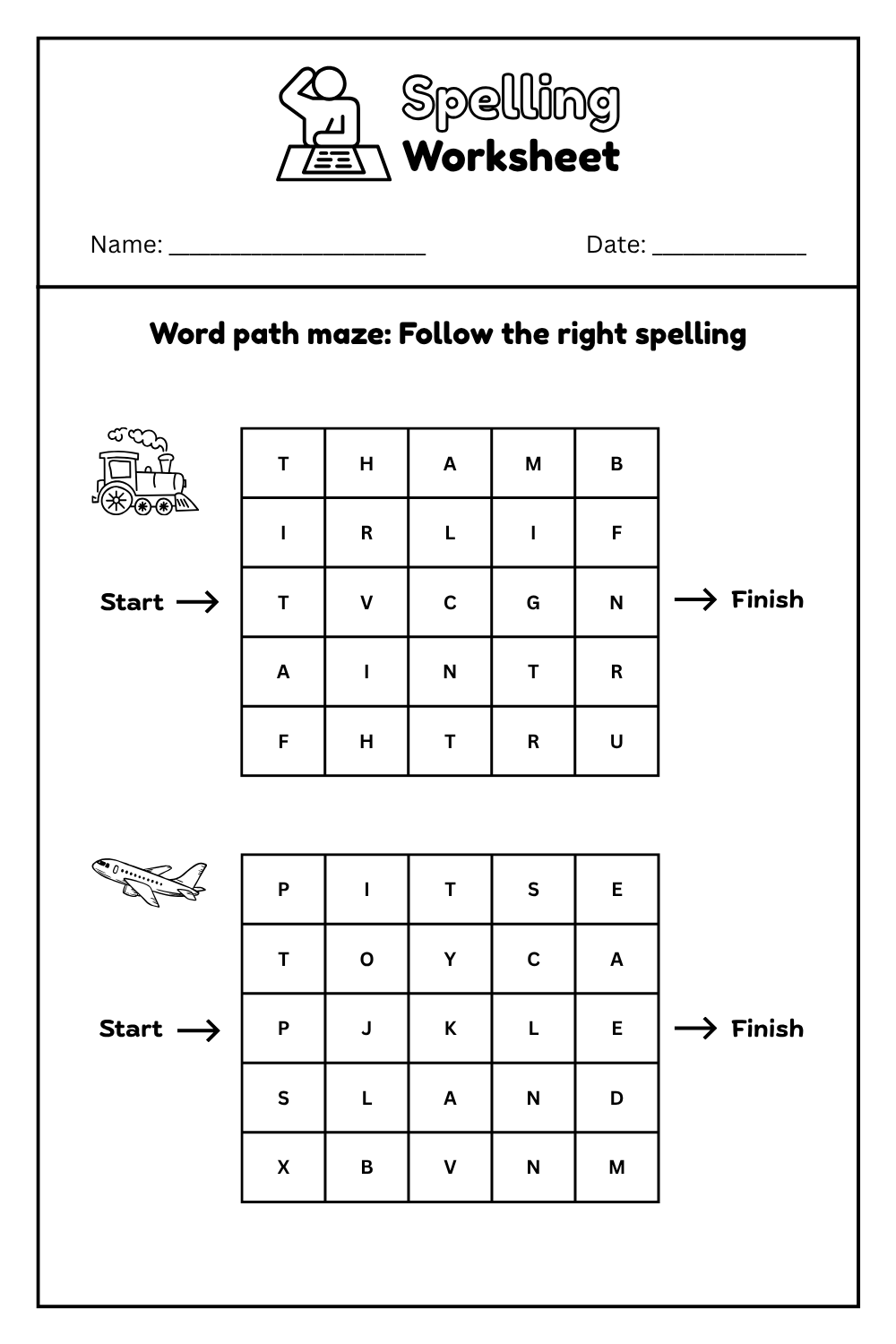
As you move forward, this worksheet has a spelling maze. Children have to follow the correct sequence of letters to reach the finish point. They need to identify the correct spelling of words hidden inside the maze. Simultaneously, they have to navigate through different letter paths.
Such an activity improves concentration and visual tracking skills. Since children enjoy game-like activities, this worksheet keeps them engaged. The pictures on the sides of the mazes are ideal to help children guess the words correctly.
Page 8
This worksheet contains incorrectly spelled words. It has pictures of a pillow, a ladder, a bucket, a candle, a rabbit, a window, a bottle, and a basket. Children must identify the mistakes and rewrite the correct spelling. It also has blank spaces below each picture.
This page is effective for testing the spelling accuracy. It also improves proofreading skills and attention to detail. When kids recognize the spelling of words, their confidence develops naturally. Hence, it is useful for revision practice and reinforcing learned vocabulary words.
Potential of spelling worksheets for kids
I am sure you must have given the above worksheets to early learners to practice spellings, and hopefully, they enjoyed these. Often, users of these worksheets shared with me the positive changes they saw in kids. I share here a few important ones:
- Kids show improvement in their letter-sound association abilities
- They improved on the identification of phonetic cues, which further helped them read fluently
- Easy recognition and recall of orthographic patterns. It means they showed increase flexibility in representing the spoken word in written form. It also means you can find improvement in their dictation-taking assignments’ scores.
- Worksheets significantly added to their knowledge of suffixes and prefixes and roots, and ultimately enhanced their words’ structural knowledge.
- Ability to derive spelling from the meaning of words improved with worksheets that had problems like ‘one-word substitution for phrases’.
Wrapping up,
There is no denying the fact that teachers or parents need different practice materials to keep children curious or engaged in spellings class. If manipulatives, board games, and practice workbooks help make the whole curriculum more interesting, worksheets further add more flavor to engaging spelling-teaching methods. With so many options to provide, the teachers can work better towards stimulating the minds of early learners and help them become fluent in solving all types of spelling-based problems.

An engineer, Maths expert, Online Tutor and animal rights activist. In more than 5+ years of my online teaching experience, I closely worked with many students struggling with dyscalculia and dyslexia. With the years passing, I learned that not much effort being put into the awareness of this learning disorder. Students with dyscalculia often misunderstood for having just a simple math fear. This is still an underresearched and understudied subject. I am also the founder of Smartynote -‘The notepad app for dyslexia’,